
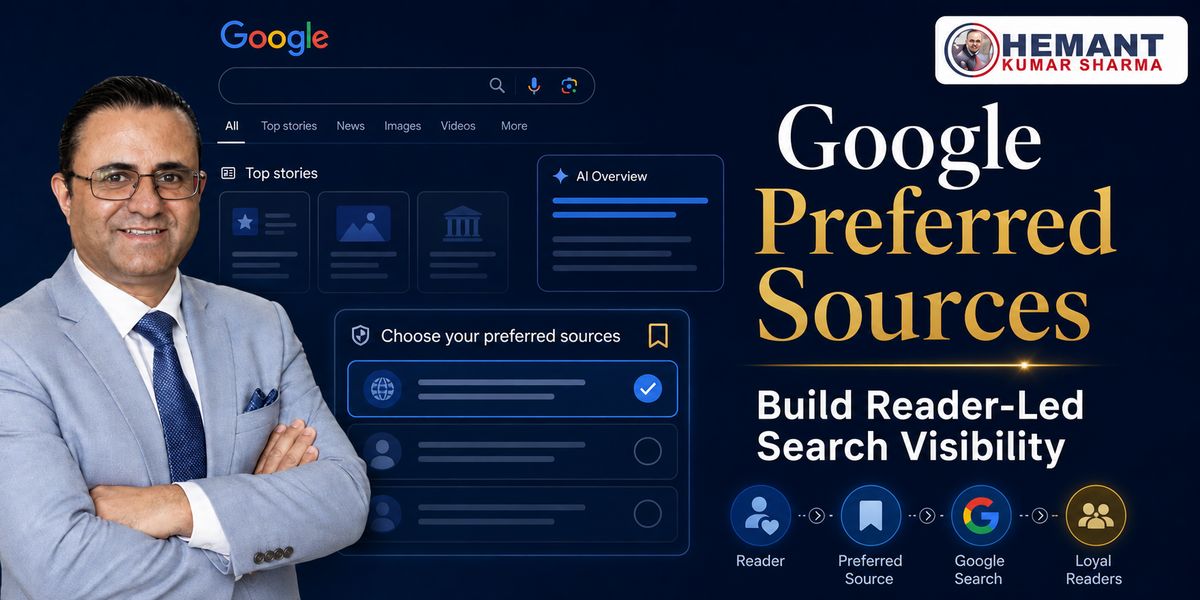
SEO mein most levers algorithm-dependent hote hain: content quality improve karo, technical issues fix karo, authority build karo aur wait karo. Google Preferred Sources ek different model introduce karta hai—reader khud website select karta hai, jisse source ka relevant content us user ke liye Google surfaces par more prominent ho sakta hai.
Google ne 20 August 2026 ko publishers ke liye interactive Preferred Sources button release kiya. Website owner button embed kar sakta hai; reader click karke site ko Preferred Source banata hai aur original page par return ho jata hai. Google says preferred sites Top Stories, AI Overviews aur AI Mode mein selected readers ke liye easier to find ho sakti hain. Company ne yeh bhi reported kiya ki users 600,000 se more unique sources select kar chuke hain.
For hemant.co.in, Indian consultants, educators, niche publishers aur business blogs, this is not a ranking shortcut. It is a direct audience-loyalty mechanism. Value tab aayegi jab website genuinely useful, regularly updated aur opt-in worthy ho.
Google ne kya announce kiya?
Confirmed facts
Google’s Search announcement 20 August 2026 ko published hua. It introduced an interactive Preferred Sources button publishers apni pages par embed kar sakte hain.
Reader flow:
1. Reader publisher page par button click karta hai.
2. Site Google par Preferred Source ke roop mein add hoti hai.
3. Reader same publisher page par return ho jata hai.
4. Relevant content Top Stories mein more often appear kar sakta hai.
5. Where available, preferred links AI Overviews aur AI Mode mein badge ke saath highlight ho sakte hain.
Google ke according, users ne 600,000 se more unique sources select kiye hain. Search Central documentation ke mutabik feature Top Stories ke liye globally supported Google Search languages mein available hai. AI Mode aur AI Overviews presence un locales par depend karegi jahan those experiences available hain.
Eligibility detail
Google says domain-level aur subdomain-level sites eligible hain:
• https://example.com — eligible
• https://news.example.com — eligible
• https://example.com/blog — as a subdirectory, separately eligible source nahi
This does not mean blog-subdirectory content excluded hai. Preferred Source selection domain level par hoti hai.
Why this matters for Indian publishers and personal brands
Analysis
Traditional organic search visitor often one-time visitor hota hai. Preferred Sources reader relationship ko repeat visibility mein convert karne ki koshish karta hai. A reader who trusts a consultant’s analysis can explicitly signal that preference instead of relying only on algorithmic rediscovery.
Indian personal brands ke liye yeh useful ho sakta hai because:
• Niche expertise broad media authority se different hoti hai.
• Hinglish and India-specific explanations loyal audience create kar sakte hain.
• Consultants news ko practical business implications mein translate karte hain.
• Email, LinkedIn, WhatsApp aur social followers ko website preference action mein convert kiya ja sakta hai.
• AI Search mein recognizable source badge trust recall improve kar sakta hai.
But preferred status relevance replace nahi karta. User ne site select ki, phir bhi content query aur topic se match hona chahiye.
Top Stories, AI Overviews and AI Mode: distinction samjhiye
Top Stories
This is the clearest use case. If selected site timely and relevant content publish karti hai, content user ke Top Stories experience mein more prominently appear kar sakta hai.
AI Overviews and AI Mode
Google documentation says selected sources can receive a Preferred badge when their content appears in AI Overviews or AI Mode, where available. Button content ko automatically AI answer mein force nahi karta. Page still relevant hona aur Google systems ke dwara supporting source select hona zaroori hai.
Confirmed fact versus inference
Confirmed: Preferred badge and selection mechanism exist.
Inference: Badge may improve recognition and click confidence for loyal readers. Google has not promised specific traffic growth for every publisher or a universal ranking boost.
How to implement the Preferred Sources button
Standard implementation
Google recommends standard JavaScript implementation. Documentation provides two lines:
<script async src=”https://news.google.com/swg/js/v1/publisher.js”></script>
<div google-add-preferred-source-btn></div>
Script normally page head mein load hota hai; div us location par place hota hai jahan button render karna hai.
Theme option
Dark layout ke liye div mein data-theme=”dark” attribute add kiya ja sakta hai.
Language option
Default button browser language follow karta hai. Publisher supported language code specify kar sakta hai. Hinglish article par automatic localized behavior generally better ho sakta hai, but testing necessary hai.
Alternative implementations
Google advanced JavaScript option custom design ke liye offer karta hai. If CMS JavaScript allow nahi karta, deeplink use kiya ja sakta hai. Deeplink social posts, newsletters aur promotional assets mein bhi share ho sakta hai.
WordPress implementation approach
For a WordPress website, three practical routes hain:
1. Theme or child-theme integration
Developer script ko safely enqueue kare aur button selected template position par add kare.
2. Header/footer or code-snippet plugin
Only trusted, maintained plugin use karein. Site-wide insertion se pehle staging test karein.
3. Custom block or reusable pattern
Button ko article end, author box ya subscription CTA section mein consistently place karein.
Direct production edit avoid karein. Backup, staging test, mobile view, Core Web Vitals aur consent setup review karein.
A 14-day implementation and promotion plan
Days 1–2: Eligibility check
Google source preferences tool mein domain search karein. Correct canonical domain, HTTPS, indexability aur publisher identity verify karein.
Days 3–4: Technical staging
Standard button staging par add karein. Desktop/mobile, light/dark theme, logged-in/logged-out flow aur return-to-page behavior test karein.
Days 5–6: Placement and copy
Article-end and author-box placements compare karein. CTA visual hierarchy clear ho but newsletter, consultation aur main conversion CTA ko compete na kare.
Day 7: Production rollout
Backup ke baad limited templates par deploy karein. JavaScript errors, page speed aur layout shift monitor karein.
Days 8–10: Existing audience activation
LinkedIn, Facebook, X, WhatsApp Channel aur email subscribers ko one clear message send karein. Benefit explain karein: future articles from a trusted source more easily find kiye ja sakte hain.
Days 11–14: Measurement
Google cited documentation mein publisher preference-count dashboard promise nahi karta. Proxy measurement use karein:
• Button visibility
• CTA clicks where first-party event tracking possible ho
• Deeplink campaign clicks
• Returning organic users
• Branded search trend
• Top Stories and AI Search referral patterns
• Promoted articles ka engagement
Sensitive user-level preference data without valid purpose and privacy review collect ya infer na karein.
Content strategy after implementation
Preferred Sources button weak publication ko strong nahi banata. Supporting content system mein yeh include hona chahiye:
Timely analysis
Platform update ka headline repeat karne ke bajay event date, rollout status, official source and practical India impact explain karein.
Original perspective
Personal experience, audit frameworks, checklists and real decision criteria content ko substitutable summary se different banate hain.
Consistent topic clusters
SEO, Google Ads, Meta Ads, LinkedIn, WordPress, AI adoption aur Indian digital business—clear clusters readers ko know what to expect help karte hain.
Entity clarity
Author name, expertise, About page, contact details, organization/schema basics and consistent branding publication identity clear karte hain.
Responsible promotion
Reader ko benefit explain karein, pressure nahi. Preferred-source selection voluntary and reversible hai.
India-specific opportunities and cautions
Regional-language opportunity
Feature Top Stories ke liye supported Search languages mein globally available hai. Hindi aur regional-language publishers audience ko option explain kar sakte hain. AI-surface availability different ho sakti hai, so local testing zaroori hai.
Newsworthiness matters
Top Stories timely topics favour karta hai. Evergreen consulting content useful hai, but every article news surface ke liye suitable nahi. Balanced calendar rakhein: timely verified developments plus deep evergreen guides.
Personal brand versus news publisher
A consultant ko mass newsroom banne ki zaroorat nahi. Consistent high-value commentary in a defined area enough ho sakti hai to earn reader preference.
No guaranteed SEO uplift
Preferred Sources user-specific personalization hai. It is not confirmed as a general ranking factor. Client proposal ya sales pitch mein guaranteed traffic lever present na karein.
What to implement, what to avoid
Implement
• Official standard button or deeplink
• One or two high-intent placements
• Clear reader-benefit CTA
• Staging and mobile testing
• First-party proxy measurement
• Consistent source-linked content
Avoid
• Fake urgency or forced opt-in
• Ranking guarantees
• Excessive site-wide repetition
• Unsupported custom code
• Assuming AI Mode visibility in every Indian account
• Treating 600,000 selections as 600,000 publishers receiving traffic
Confirmed facts versus analysis
Confirmed:
• Google announced the interactive button on 20 August 2026.
• It can add a site as Preferred Source and return the reader to the page.
• Preferred Sources can influence Top Stories visibility and appear with badges in eligible AI Search surfaces.
• More than 600,000 unique sources have been selected.
• Domain and subdomain sources are eligible; subdirectories are not independently eligible.
• Google provides standard JavaScript, advanced JavaScript and deeplink routes.
Analysis:
• The button is most valuable as a loyalty and repeat-discovery tool.
• hemant.co.in should place it near article conclusions or author areas.
• LinkedIn, WhatsApp and email audiences are strong initial activation channels.
• Measurement should use transparent proxy indicators, not invented preference counts.
Conclusion
Google Preferred Sources gives publishers something rare: a reader-controlled visibility signal. It does not replace SEO, content quality or authority, but it can help a trusted site remain easier to find across Top Stories and eligible AI Search experiences.
For Indian consultants, educators and niche publishers, implementation is simple; earning the click is the real work. Publish useful, verifiable insights consistently, then invite readers to choose your website—without exaggerating what the feature guarantees.
Apni website ki SEO, AI Search visibility, content strategy aur WordPress implementation professionally align karna chahte hain? Hemant Kumar Sharma se consultation ke liye visit karein: https://hemant.co.in
Call or WhatsApp: +91 98116 81687
Sources and verification notes
1. Google Search Blog, published 20 August 2026:
https://blog.google/products-and-platforms/products/search/personalize-search-discover-news
2. Google Search Central, Preferred Sources implementation guide, accessed 22 August 2026:
https://developers.google.com/search/docs/appearance/preferred-sources
3. Google’s original Preferred Sources launch announcement, published 12 August 2025:
https://blog.google/products-and-platforms/products/search/preferred-sources
Verification note: Details were rechecked on 22 August 2026. Top Stories availability and AI Search eligibility are separate because AI Overviews and AI Mode availability varies by locale and account.