

How website management, business email, hosting, content architecture and SEO have evolved alongside an established Indian corporate services group.
Case study category: Long-Term Digital Partnership | Corporate Website | Business Email | Hosting | SEO
Client: Hemkunt Group
Relationship: 1999–present (ongoing as at October 2026)
Consultant: Hemant Kumar Sharma
Infrastructure partner: Dinsol India
The story at a glance
Many digital marketing case studies begin with a campaign and end with a conversion chart. The work with Hemkunt Group is different. It is a record of a business relationship that has continued since 1999, through changes in website technology, hosting practices, corporate email, visitor behaviour and search.
The assignment has never been limited to launching one website. It has involved maintaining the digital infrastructure a business depends upon, then adapting its online presentation as the business and the internet have changed. That continuity is the central result of this engagement.
Partnership timeline
1999: The professional association and digital foundation begin.
Subsequent years: Continuing website management, hosting, business email and technical support.
2025–2026: Website information architecture, service presentation, content and SEO evolve.
October 2026: The relationship continues, with website and infrastructure support as required.
About Hemkunt Group
Established in 1973, Hemkunt Group has grown into an Indian services organisation working with corporate, industrial and institutional clients. Its principal service areas are integrated facility management, hospitality and corporate guest-house management, and HR, staffing and outsourcing.
Its group structure includes Hemkunt Special Services, associated with facility and guest-house operations, and Simply Better Services India Pvt. Ltd. (SBS India), associated with HR and manpower solutions. These activities serve different buyer needs, even though they belong to the same wider business identity.
The company’s corporate website is therefore expected to do several jobs: introduce the organisation, explain different service lines, support buyer confidence and make it straightforward for prospective customers to find the right team.
The central challenge: change without losing continuity
An established business cannot treat every digital upgrade as a completely new start. Websites change, software changes, and the language customers use to search for services changes. But domain-based communication, accumulated content, company identity and day-to-day accessibility must continue.
For Hemkunt Group, the practical challenge has been to maintain a dependable digital presence while making it more useful to modern corporate buyers. Over the years, the work has moved from the fundamental requirements of a professional online presence to more structured service pages, clearer navigation and ongoing search optimisation.
The governing principle has remained consistent: modernise what needs modernising without disrupting what the business already relies on.
Phase 1: A digital foundation beginning in 1999
The professional association began in 1999, when the everyday digital requirements of Indian businesses looked very different from those of 2026. Corporate websites were primarily reference points. Domain-based email was becoming an important part of formal business communication. Hosting and technical support required practical, continuing attention.
The early relationship developed around establishing and maintaining that digital foundation. Across the subsequent years, support has included corporate website management, web hosting, business email infrastructure, maintenance, content updates and technical troubleshooting.
These responsibilities are not always visible to a prospective customer. Their value becomes apparent when a company can continue using its digital presence while successive generations of technology change behind it.
A hosting change, website update or email configuration should not require the business to start its communications and public identity from zero. Maintaining that continuity was an important part of the relationship.
Phase 2: Making a growing service portfolio easier to understand
As Hemkunt Group’s service portfolio became broader, the website needed to explain more than the organisation’s history. Visitors needed a clearer route to the relevant capability.
Three service areas became particularly important to the website’s information architecture:
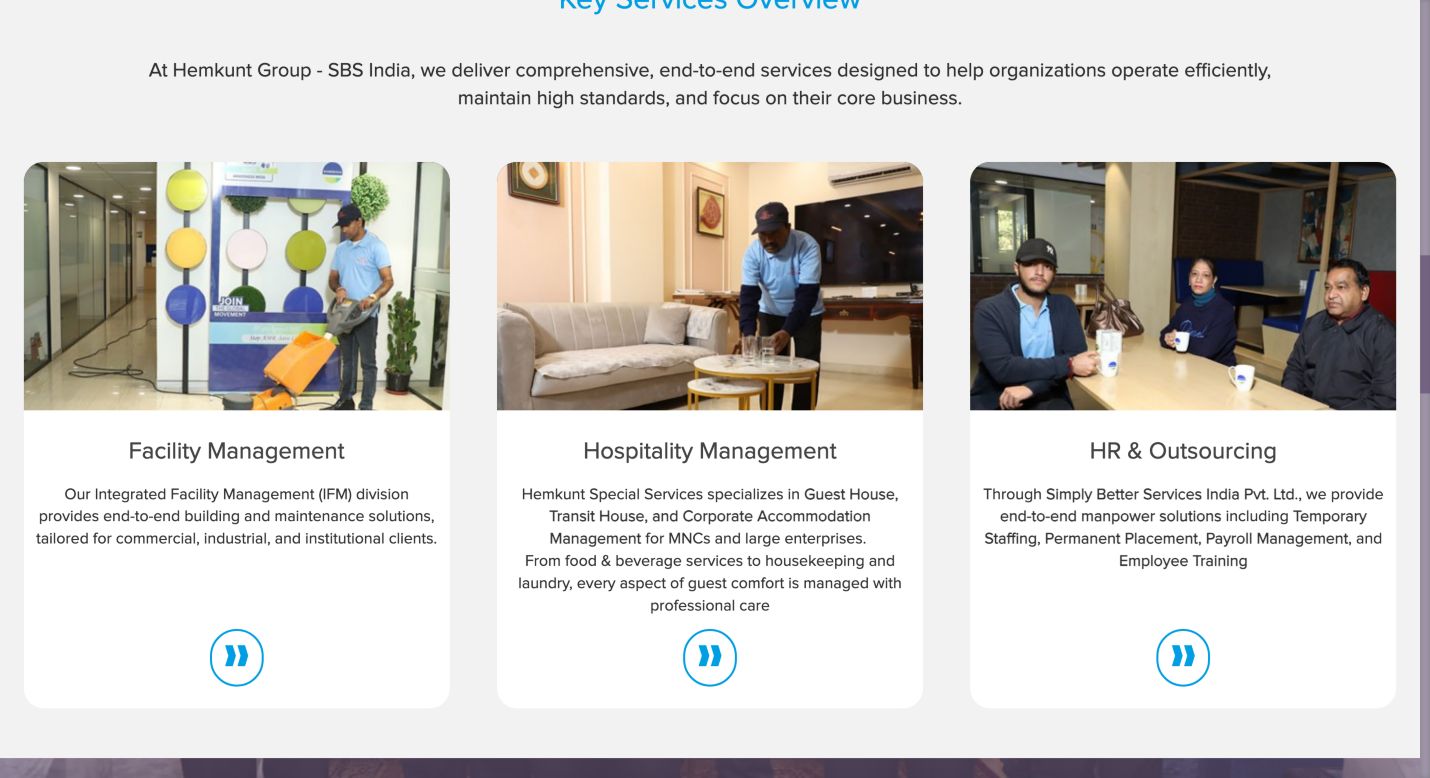
- Facility Management: Building maintenance, electrical support, housekeeping, plumbing, refurbishment, pest-control support and related operational services.
- Hospitality Management: Corporate guest houses, transit accommodation and hospitality operations requiring a distinct presentation.
- HR & Outsourcing: Staffing, payroll, recruitment, compliance, training and workforce-related services.
The objective was not to make the menu longer. It was to help a corporate visitor identify the correct business line without reading through several unrelated pages.
A more useful journey follows a straightforward sequence: understand the group → identify the service division → assess relevant capabilities → review credibility → make contact.
This change matters particularly in B2B services, where the person researching a vendor may be preparing a shortlist for other decision-makers rather than making an immediate purchase.
Phase 3: Website structure and user experience in 2025–2026
During the 2025–2026 redevelopment and review cycle, work concentrated on the way information was organised and presented. Service-page structure, navigation, visual service cards, corporate information and enquiry journeys were considered together.
The broader site architecture covered more than the three service pillars. Areas such as group structure, company background, leadership, certifications, key clients, testimonials, case studies, careers, project photographs, insights and contact information contribute to how a corporate visitor evaluates a potential service provider.
This approach treats the website as a working business reference rather than a static brochure. A clear service architecture helps the visitor understand the offer; supporting company information helps the visitor judge whether to take the next step.
The current website presents Facility Management, Hospitality Management and HR & Outsourcing as distinct entry points, supported by corporate and informational sections. It is a visible expression of the more structured direction developed through the engagement.
Phase 4: Connecting SEO with the website’s actual services
Search optimisation formed a further layer of the work as online research became a routine part of corporate vendor selection.
The SEO approach addressed page titles and descriptions, heading consistency, service-related search intent, page content, internal linking, URL alignment and structured business/service information. The objective was to give each important service page a clearer purpose for visitors and search engines alike.
This involved considering core areas of the website, including the homepage, individual service sections, About, case studies, contact and informational articles. Rather than viewing SEO as separate from the website, the work connected search readiness with the same service structure that visitors use to navigate.
For a facility-management or outsourcing provider, relevant search visibility is only one part of the journey. A prospective buyer arriving from search must still understand the service, assess the company’s credibility and find an appropriate enquiry route.
That is why technical SEO, content clarity, information architecture and user experience were treated as connected responsibilities.
The less visible responsibility: hosting and business email
Website design receives attention because people can see it. Business email and hosting attract less notice when they work as expected. Yet they support some of the most basic requirements of an established organisation.
Domain-based business email carries communication with clients, suppliers, employees and other stakeholders. Hosting supports the availability of a website that customers may consult at any point in their buying journey. Domain and DNS configuration, website technology and security practices also change over time.
Within the Hemkunt Group relationship, website management and technical infrastructure have remained part of the continuing service. The company’s website currently acknowledges this arrangement publicly in its footer: “Website Managed by Hemant Kumar Sharma” and “Hosted by Dinsol India.”
That acknowledgement is especially relevant here because the case study is about ongoing responsibility, not a short-lived campaign.
What the engagement has delivered
The impact is best understood through the continuity of support and the improvements to the website’s structure and service presentation.
Continuity of digital support. The relationship has continued since 1999 while the tools and requirements surrounding corporate websites and business communication have changed repeatedly.
Clearer service presentation. The website’s principal routes reflect the organisation’s facility-management, hospitality and HR-outsourcing capabilities rather than presenting all services as one undifferentiated list.
A broader corporate credibility platform. The website’s structure accommodates service explanations and supporting information such as company background, clients, case studies, certifications, insights and contact routes.
Search-oriented organisation. SEO work has been applied to the content and architecture of key pages rather than being treated only as a separate list of keywords.
Continuing technical stewardship. Website management, hosting and business email support have remained part of the wider professional association.
These are the outcomes relevant to this case. The work should not be represented as the sole cause of Hemkunt Group’s business development, operational achievements or market reputation. Those belong principally to the organisation and its management.
Why this is different from a conventional campaign case study
A campaign case study might measure cost per lead, traffic growth or attributed sales within a fixed period. A long-running infrastructure and website relationship requires a different lens.
The questions are whether the digital presence continues to serve the business, whether changes are made with an understanding of its history, whether separate services become easier for buyers to understand, and whether the technical foundations remain accounted for as new requirements emerge.
Hemkunt Group illustrates a model built around continuity with informed change. The technology has changed several times. The organisation’s service requirements have developed. The working relationship has continued.
Role of Hemant Kumar Sharma
Depending on the period and the requirement, the engagement has covered website consultation and management, hosting and business email support, technical troubleshooting, information architecture, service presentation, content organisation, SEO and search-readiness planning.
The role is better described as a long-term digital partner than as a one-time website developer or an isolated SEO supplier. It involves knowing what should be retained as carefully as knowing what needs to be improved.
The continuing journey
This is an ongoing engagement, not a completed assignment. Website management, hosting and the improvement of corporate content and search visibility remain continuing areas of support as required.
For established businesses, the principal lesson is practical: digital development need not be a series of disconnected supplier changes and redesigns. With sufficient continuity, an organisation can improve its online presence while retaining the accumulated understanding behind it.
Since 1999, Hemkunt Group’s digital requirements have changed. The professional relationship supporting them has continued.
Need a long-term digital partner for your business?
If your website, business email, hosting, content and SEO are being handled as separate activities, a strategic review can help identify what should remain, what needs improvement and which changes deserve priority.
Explore digital marketing consultation options with Hemant Kumar Sharma, or review more client case studies.
Case study context: This article covers a continuing client relationship as described in the project records through October 2026. It is a study of digital stewardship, website structure and ongoing support; it does not claim quantified advertising, SEO traffic or sales growth for this engagement.
Need Better Direction for Your Business Growth, Online Presence or Marketing Decisions?
Whether you need expert consultation, mentoring guidance, structured training or professional execution support, the next step should be clear, practical and commercially meaningful.
Choose the next step that fits you best
This strategic session gives you the deep clarity that most businesses lack. Instead of guessing, testing randomly, or wasting money on disconnected marketing, after attending you walk away with a clear, structured roadmap that eliminates confusion and provides a step-by-step action plan to move forward confidently.