

How clearer professional positioning, a structured editorial system and targeted audience development helped organise existing expertise into a more focused LinkedIn presence.
Case study type: LinkedIn Personal Branding & Thought Leadership
Client: Bikramjit Konwar
Principal engagement: October 2025–early 2026; key audience results measured over 28 days in February 2026
Services: LinkedIn Profile Audit | Personal Brand Positioning | Content Strategy | LinkedIn Profile Optimisation | Thought Leadership | Audience Development | Analytics
Consultant: Hemant Kumar Sharma / Enovate Digital
Original thought-leadership creative showcase
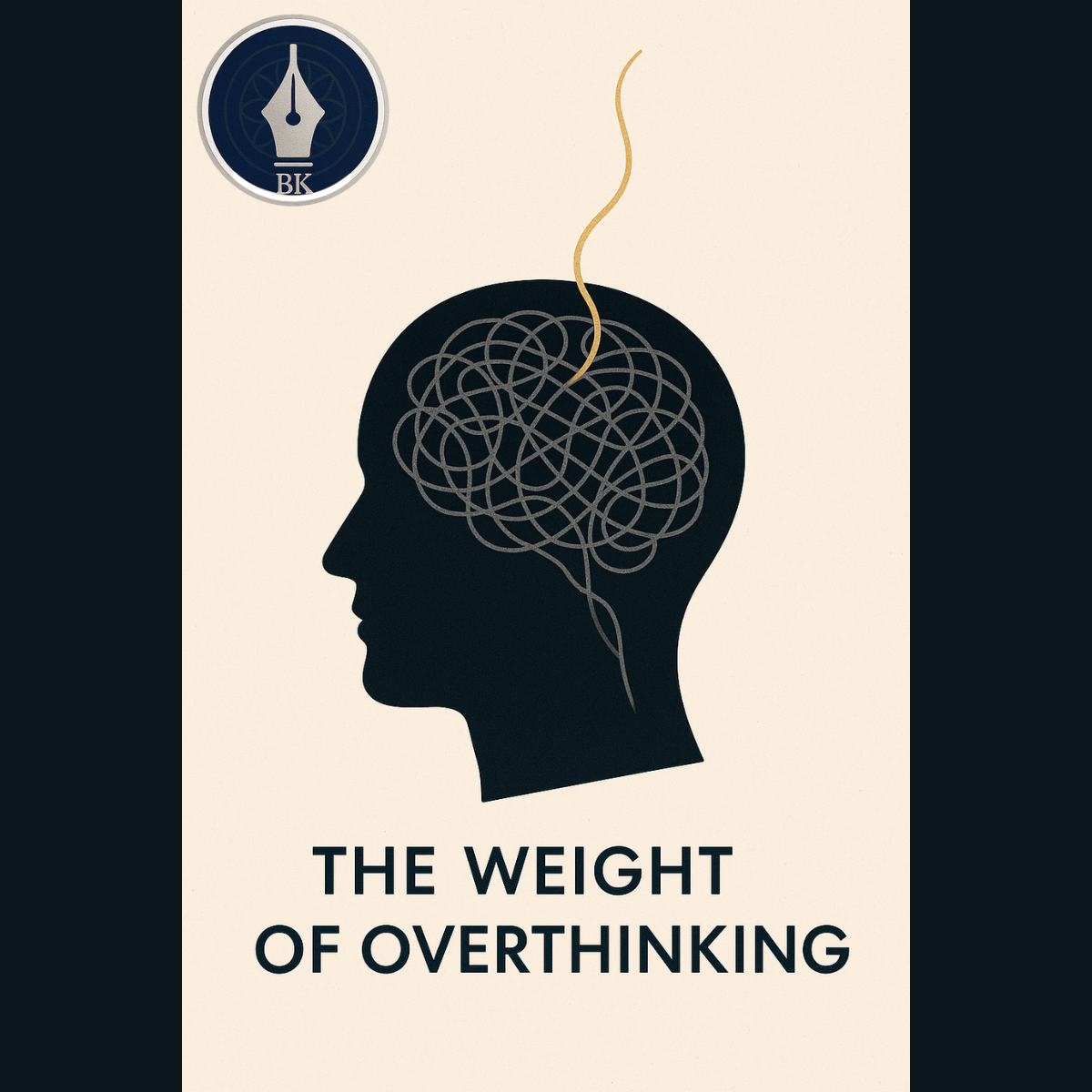
Distinct branded artworks from the October 2025 project archive illustrate the visual language used for stillness, authentic living, overthinking, writing, mindful pauses and balance. Select an image to view it in full.




The problem was not a lack of expertise
LinkedIn personal branding is often reduced to a publishing schedule: write more posts, design more carousels, send more connection requests and hope that visibility follows. That approach can leave the central problem untouched. If someone visits a professional profile and cannot quickly understand what the person stands for, additional publishing may only amplify the confusion.
That was the challenge addressed in the LinkedIn engagement with Bikramjit Konwar. He already had substantial original material: articles, quotations, educational writing, longer-form ideas and three audience-oriented eBooks. His thinking ranged across human behaviour, leadership, mindfulness, learning, professional performance and the changing place of AI in working life. The issue was not the quality or quantity of his intellectual interests. It was the absence of a consistent, market-facing framework connecting them.
The assignment began around October 2025 and continued into early 2026. It involved more than rewriting a headline. We needed to decide which areas of expertise should lead the professional identity, how the LinkedIn profile would explain them, what content formats could demonstrate them, and which audiences were worth developing.
The central question was: What should a relevant visitor remember Bikramjit for after encountering his profile and content?
The starting point: substantial ideas, fragmented presentation
Historical LinkedIn reviews covered periods including 1 July–30 September 2025 and 10 September–9 October 2025. They showed comparatively modest reach and engagement, albeit with indications of improvement. Image-led posts dominated the format mix, while text-based insights, carousels, long-form articles and more structured authority assets were underused opportunities.
The existing material also arrived in different forms and at different times: a quotation here, an article idea there, a wider reflection to be adapted for LinkedIn. Without a common content framework, even good material could become a sequence of unrelated posts.
The positioning work therefore needed to answer several practical questions. Who should the professional profile reach? What was the strongest connecting idea? Which subjects could demonstrate expertise without creating another competing identity? How should a short post relate to a longer essay or whitepaper? And what role, if any, should a supporting company page play?
These are branding and content-architecture questions before they are algorithm or posting-frequency questions.
Strategic decision 1: give the professional identity a centre
A recurring direction in the project was clarity—not only as a topic Bikramjit wrote about, but as the organising idea of the brand. The positioning developed around a writer and educator working with human behaviour, fundamental clarity, mindful high performance, learning and leadership.
The core themes became:
One especially useful expression of this direction was “Clarity Drives Performance.” It informed the LinkedIn banner concept, supported by the language “Human Behaviour • Fundamental Clarity • Mindful High Performance” and “Whitepapers | Learning Content | Thought Leadership Essays.”
The aim was not to claim that one slogan caused follower growth. It was to ensure that the headline, banner, About section, Featured assets and editorial themes were conveying the same professional territory.
A profile that mentions everything a person knows can inadvertently make it harder for the right audience to understand what that person offers. In this engagement, the strongest direction came from selecting a few connected intellectual themes and repeatedly exploring them from different angles. The brand became clearer by making deliberate decisions about what was central and what belonged in a supporting role.
Strategic decision 2: keep AI relevant without making it the identity
AI was an increasingly visible subject on LinkedIn during the project period. Bikramjit had a legitimate perspective on AI through human behaviour, ethics, cognition and leadership. However, a wholesale shift toward a generic AI-expert identity would have diluted the clearer position being established.
The strategy kept AI-related content as a supporting theme, interpreted through the existing human-behaviour and performance positioning. It was an editorial direction rather than an audited claim about the published content mix.
Put simply, AI was a context; human behaviour remained the subject. That decision protected the profile from changing its professional identity whenever a new topic became popular.
Building the profile around a recognisable professional proposition
Once the positioning had been established, the profile components could be treated as a connected system rather than a set of separate boxes.
The headline direction placed the identity ahead of a long inventory of skills. One proposed formulation described Bikramjit as a clarity-driven writer working across human behaviour, fundamental clarity, mindful high performance, whitepapers, learning content and thought-leadership essays.
The About section was developed as a professional narrative: the problems he examines, why clarity matters, who can benefit from his ideas and what forms of educational or thought-leadership work he produces. The goal was to explain the value of the thinking, not simply list credentials or repeat the headline.
The banner concept used “Clarity Drives Performance” to make the professional territory visible at a glance. Visual direction was deliberately calm, minimal and research-led rather than crowded with promotional claims. A recognisable profile is often built as much through restraint as through more graphic elements.
Instead of choosing Featured items solely because they attracted attention, the plan prioritised pieces that could demonstrate capability: whitepapers or PDFs, substantive articles, structured carousels, a Gamma presentation or another well-developed learning asset.
A short post can start a conversation. A good long-form asset can give a prospective collaborator or client a reason to investigate further. The Featured section was planned to connect those two functions.
From individual posts to a repeatable editorial system
A significant part of the engagement was editorial organisation. The delivery and planning records included 30-day content calendars, ready-to-publish posts, carousel concepts and design briefs, article drafts, single-image concepts, banner language and profile copy.
Rather than assigning every original quotation or idea directly to the next available posting date, it could first be classified by content pillar, intended audience, message, format and depth. This helped determine whether the idea was best expressed as a brief observation, an educational carousel, a longer essay or an authority document.
One central content thesis illustrated the approach: “Clarity > Motivation”—the idea that motivation may fluctuate, while clarity can provide a more durable basis for decisions and performance. That concept could support discussions about attention, leadership, burnout, learning and organisational decision-making without making those posts feel unrelated.
The company page was deliberately assigned a secondary supporting role, with a suggested cadence of approximately two posts per week. The personal profile remained the main channel for establishing Bikramjit’s individual authority. The strategy did not assume that limited resources should be split equally between both destinations.
Audience development: relevant connections, not indiscriminate volume
The audience plan prioritised professional fit through consistent, relevant connection activity with people whose interests and responsibilities matched the positioning. Detailed activity targets remain confidential.
Priority groups included founders, CEOs and managing directors, HR and learning-and-development professionals, organisational-development leaders, leadership trainers, coaches, consulting professionals and transformation specialists. India remained an important market, with relevant professional relationships also sought across the UK, USA and Europe.
The strategy made a distinction between audience size and audience relevance. For a thought-leadership brand, ten relevant professionals who understand the work may be more commercially meaningful than a much larger audience with little connection to the subject. The historical project records did not supply a verified count of enquiries or signed consulting engagements, so those outcomes are not claimed here.
Audience development during the documented period
During the February 2026 profile-first phase, LinkedIn analytics recorded approximately 20% follower growth over the documented reporting window. Absolute audience figures and detailed audience composition remain confidential.
Clearer positioning and structured publishing coincided with audience development. The review considered professional relevance alongside growth, without publishing the client’s detailed audience breakdown.
Interpretation: Clearer positioning and structured publishing coincided with audience development. This does not establish that any individual profile edit caused the growth, or that it translated into leads, booked sessions or revenue.
A deliberate 60-day rule: do not keep changing the identity
After promising audience development, a common temptation is to change the headline again, introduce a fashionable new specialisation or rebuild the content system around whichever post performed best last week.
The project recommended approximately 60 days of positioning stability before making major identity changes. That gave the headline, banner and content pillars time to reinforce one another. The decision did not mean ignoring analytics; it meant using them to improve execution without constantly changing what the professional brand stood for.
A clearer identity is useful only when the audience is allowed to encounter it consistently.
What changed through the engagement
The profile had a clearer centre. The relationship between human behaviour, clarity, leadership and professional performance became easier to explain.
Profile components became more coherent. Headline, About section, banner and Featured-section planning were developed around one professional proposition.
Original ideas became usable editorial material. Content pillars and repeatable calendars helped turn diverse intellectual inputs into connected posts, articles and presentations.
Formats were assigned distinct roles. Short text posts could spark conversation, carousels could explain ideas, and long-form assets could demonstrate depth.
Audience development became more selective. The recommended connection routine emphasised the relevance of professional relationships over mass expansion.
The measurable audience grew by approximately 20% during the documented February 2026 reporting window. This is a relative audience measure, not a claim about commercial return.
Trend-led repositioning was discouraged. AI remained a supporting topic, and a stability period was recommended before making another substantial identity change.
Later profile evolution belongs to a separate timeline
The original case-study review also noted that Bikramjit’s public profile continued to develop after the main engagement, with continued writing about workplace performance, behaviour, leadership, education and AI through a human-performance lens. These later observations are useful background, but subsequent followers, positioning changes or commercial outcomes are not attributed to the October 2025–early 2026 assignment.
This case study is primarily about the positioning system developed during the engagement, with the February audience metrics as time-bounded supporting evidence.
Role of Hemant Kumar Sharma / Enovate Digital
The consultancy and delivery work covered LinkedIn profile auditing, personal-brand positioning, headline and About-section strategy, banner direction, Featured-section planning, audience definition, connection strategy, content pillars, thought-leadership writing, 30-day calendars, carousel and design briefs, company-page guidance, analytics interpretation and recommendations for positioning stability.
This was not simply a LinkedIn content-posting assignment. The more important responsibility was to organise existing expertise into a professional identity and a publication system that the intended audience could recognise.
The lesson: establish clarity before scaling content
The Bikramjit Konwar engagement illustrates a practical distinction in LinkedIn consulting. More content can create more opportunities to be seen, but it does not automatically clarify what a professional should be known for. Here, the more useful sequence was:
Existing Expertise → Positioning Audit → Clear Professional Identity → Profile Architecture → Content Pillars → Authority Assets → Relevant Audience Development → Measurement → Positioning Stability
A serious personal brand need not speak about fewer ideas forever. It does need a recognisable centre that holds those ideas together. In this project, clarity was both the subject of the content and the principle used to develop the brand.
Is your LinkedIn presence active but difficult to position?
If your profile already contains experience, useful knowledge and regular posts but your intended audience still struggles to understand your professional proposition, publishing more may not be the first priority. An experienced LinkedIn review can help distinguish what should be highlighted, what belongs in supporting content and how your profile and publishing system can work together.
Explore digital marketing consultation options with Hemant Kumar Sharma, or review additional work in the Case Studies Library.
Historical reporting note: The core project period was October 2025–early 2026. The rounded growth percentage relates to the documented February 2026 reporting window. Recommendations are distinguished from audited execution; no unrecorded leads, sales or revenue are attributed to the engagement.
Need Better Direction for Your Business Growth, Online Presence or Marketing Decisions?
Whether you need expert consultation, mentoring guidance, structured training or professional execution support, the next step should be clear, practical and commercially meaningful.
Choose the next step that fits you best
This strategic session gives you the deep clarity that most businesses lack. Instead of guessing, testing randomly, or wasting money on disconnected marketing, after attending you walk away with a clear, structured roadmap that eliminates confusion and provides a step-by-step action plan to move forward confidently.