
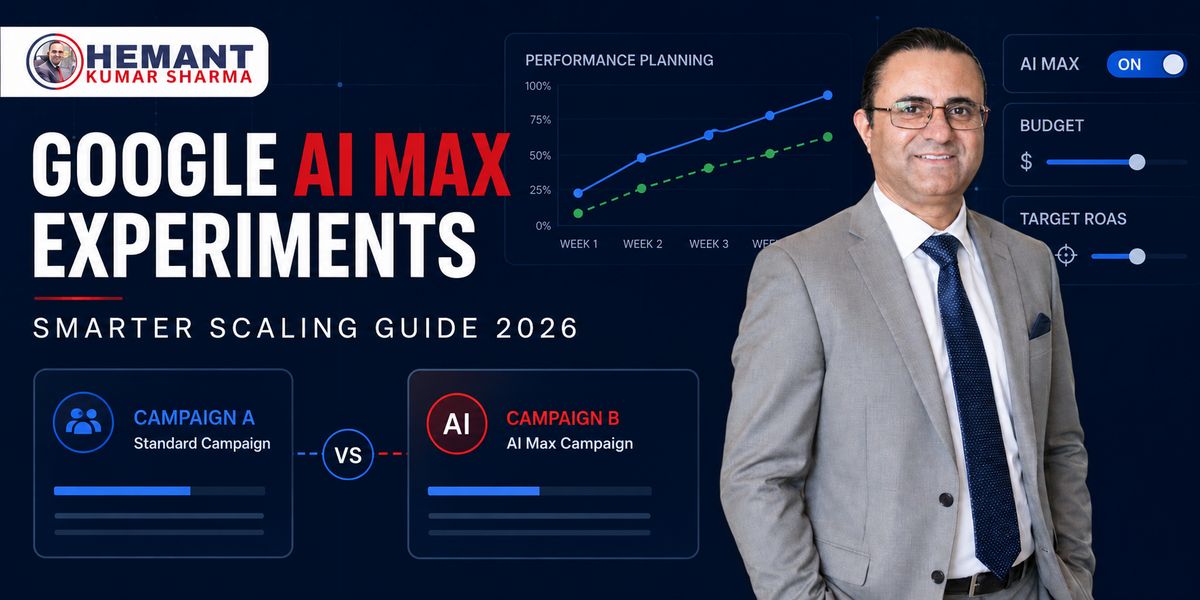
Google Ads mein automation badh rahi hai, lekin serious advertisers ka real concern “AI use karein ya nahi” se zyada “AI ko safely test kaise karein” hai. Budget badhana, Target CPA ya Target ROAS change karna, aur AI Max enable karna directly business outcomes affect kar sakta hai. Isliye prediction aur experiment ke beech clear difference hona chahiye.
Google ne 20 August 2026 ko AI Max for Search ke new testing and planning tools announce kiye. Advertisers multiple Search campaigns par different budgets aur ROI targets ko ek single A/B test mein compare kar sakenge. AI Max experiments ab brand aur location controls ke saath bhi run ho sakte hain. Performance Planner bidding ya budget changes ka projected impact dikha kar suggested changes apply karne ka option deta hai.
Indian businesses aur consultants ke liye opportunity useful hai: scaling decisions ko guesswork ke bajay structured evidence se support karna. Lekin result tabhi valuable hoga jab conversion tracking, lead quality, test design aur human approval strong ho.
Google ne exactly kya announce kiya?
Confirmed facts
Google Ads & Commerce Blog par announcement 20 August 2026 ko published hua. Google ke mutabik:
• Multiple Search campaigns ke budgets aur ROI targets ko ek A/B test mein evaluate karne ka option September 2026 mein roll out hona scheduled hai.
• AI Max experiments brand aur location controls enabled rakh kar run kiye ja sakte hain.
• Performance Planner existing campaign performance par bidding aur budget changes ka estimated impact dikha sakta hai.
• Suggested Performance Planner changes ko one click mein campaigns par apply kiya ja sakta hai.
• Google ne universal account-level availability date ya every-market eligibility matrix publish nahi ki.
These are platform capabilities, guaranteed performance outcomes nahi. A/B test incremental evidence de sakta hai; woh weak tracking, poor offer, unsuitable landing page ya unqualified leads ko automatically solve nahi karta.
Existing Smart Bidding article se yeh story different kyun hai?
Analysis
Earlier Smart Bidding change ka focus “Limited by budget” campaigns aur target-based bidding ke behaviour par tha. New AI Max announcement ka focus test architecture aur planning hai.
Simple distinction:
• Smart Bidding change: existing campaigns target ke closer optimise kaise honge.
• AI Max experiments: scaling hypothesis ko controlled comparison mein kaise test karein.
• Performance Planner: future budget/bid scenarios ka forecast kaise dekhein.
• Human decision: prediction aur test evidence ko business economics ke against approve kaun karega.
Isliye new tools ko earlier bidding update ka duplicate nahi, uske practical control layer ke roop mein dekhna better hai.
Multi-campaign A/B testing ka real value
Traditionally, one-campaign experiment useful hota hai, but portfolio-level scaling question ka answer incomplete reh sakta hai. Agar business ke paas brand, generic, regional aur service-specific Search campaigns hain, ek campaign ka result entire strategy represent nahi karta.
New setup potentially evaluate kar sakta hai ki coordinated budget ya ROI-target change overall performance ko kaise affect karta hai. Example: a consultancy Delhi, Mumbai aur Bengaluru ke separate campaigns run karti hai. Single A/B test mein broader scaling hypothesis evaluate karna isolated test se more representative ho sakta hai.
Still, more campaigns automatically better evidence nahi. Campaign objectives, conversion definitions aur economics comparable honi chahiye. Mixed-quality data experiment ko mathematically neat but commercially misleading bana sakta hai.
Brand aur location controls ke saath testing
Confirmed fact
Google says AI Max experiments can run while specific brand or location controls remain enabled.
Practical implication
This matters for businesses jahan reach expansion ke saath guardrails compulsory hain:
• Franchise or local-service businesses with defined service areas
• Premium brands protecting brand context
• Consultants targeting specific cities
• Regulated or territory-bound services
• Businesses excluding locations they cannot fulfil
Control enabled hona useful hai, but configuration audit still necessary hai. Location option, excluded areas, brand lists aur final URL expansion settings test launch se pehle verify karein.
Performance Planner: forecast ko promise mat samjhiye
Confirmed fact
Performance Planner bidding aur budget changes ka projected impact dikha sakta hai, and suggested changes directly apply kiye ja sakte hain.
Analysis
Forecast historical data, auction patterns aur modelling par depend karta hai. Seasonality, competitor action, price change, inventory issue, tracking breaks aur offline sales quality model ke bahar ho sakte hain.
One-click apply convenience hai, approval logic nahi. Consultant ko four questions poochne chahiye:
1. Forecast date range business cycle ko represent karta hai?
2. Conversion action actual outcome hai ya micro-conversion?
3. Projected CPA/ROAS margin aur fulfilment capacity ke andar hai?
4. Suggested change rollback ke saath document hua hai?
Indian advertisers ke liye special implications
Lead quantity versus lead quality
Education, real estate, healthcare, travel, consulting aur local services mein platform conversion often form fill ya call click hota hai. Actual qualified lead aur sale later CRM, phone ya WhatsApp mein confirm hoti hai. AI Max experiment ko sirf low CPL par judge karna galat ho sakta hai.
Qualified-lead rate, connected-call rate, appointment rate, revenue aur cancellation context add karein. Offline conversion import ready nahi hai to at least manual sample audit maintain karein.
Smaller budgets need patience
Limited daily budgets mein random variation large lag sakti hai. Short test mein one high-value conversion result distort kar sakta hai. Test duration arbitrary seven days par stop na karein. Sufficient conversion volume aur normal buying cycle ka wait karein, without inventing a universal minimum.
Regional and multilingual campaigns
Hindi, English aur regional-language campaigns ko one mixed test mein combine karna interpretation difficult bana sakta hai. Language, location, device aur landing-page experience different ho sakte hain. Comparable clusters create karein and segment-level outcomes report karein.
GST, margins and business reality
Google Ads dashboard ka conversion value net profit nahi hota. GST treatment, product cost, agency cost, returns, no-shows aur sales-team effort separate hain. ROI target ko business contribution margin ke saath map karein, not merely platform ROAS.
A practical experiment framework
Step 1: Write one testable hypothesis
Example: “Brand and service-area controls maintain karte hue AI Max treatment qualified leads ko same or acceptable acquisition cost par increase karega.”
“AI Max performance improve karega” testable enough nahi hai.
Step 2: Fix the primary business metric
Choose one primary metric: qualified lead cost, booked appointment cost, verified revenue, contribution margin, or another outcome tied to business value. CTR, search terms, impression share aur form fills diagnostic metrics rahen.
Step 3: Audit measurement before launch
• Primary conversion actions correct hain
• Duplicate conversions removed hain
• Enhanced or offline conversion process documented hai
• Call and WhatsApp events meaningful hain
• Currency and attribution settings known hain
• Consent and privacy implementation reviewed hai
Step 4: Protect experiment integrity
Test ke beech large creative, landing-page, pricing, geography ya conversion changes avoid karein. Unavoidable business change ho to annotate karein and interpretation accordingly qualify karein.
Step 5: Predefine decision rules
Launch se pehle decide karein:
• What result supports rollout?
• What result needs more data?
• What result triggers rollback?
• Which guardrails cannot be compromised?
• Who approves budget application?
Step 6: Review quality, not just averages
Campaign total ke saath search terms, geography, device, time, lead quality aur sales outcomes review karein. Average CPA improvement ek high-value region ki deterioration hide kar sakta hai.
What to test, what to avoid
Test first
• One coherent group of Search campaigns
• Clearly defined budget or ROI-target hypothesis
• Brand/location controls where operationally necessary
• Verified primary conversions
• Documented baseline and rollback path
Avoid
• All campaigns simultaneously change karna
• Weak tracking par automation add karna
• Forecast ko guarantee present karna
• One-click apply without approval
• Platform leads ko qualified revenue assume karna
• Test period ke beech unrelated optimisation
Confirmed facts versus analysis
Confirmed:
• Google announced the tools on 20 August 2026.
• Multi-campaign budget and ROI-target A/B testing is scheduled for September.
• AI Max experiments support brand and location controls.
• Performance Planner can model bidding/budget changes and apply suggestions.
Analysis:
• Indian service businesses should optimise against qualified outcomes, not raw leads.
• Multi-campaign testing is useful only when objectives and measurement are comparable.
• One-click application increases the need for approval and rollback.
• Smaller or seasonal accounts may need more patience before conclusions.
Conclusion
Google AI Max ka strongest use blind automation nahi, controlled learning hai. New experiments scaling decisions test karne ka better structure dete hain, while Performance Planner scenario thinking faster bana sakta hai.
Competitive advantage tool access nahi hoga—clean measurement, meaningful hypotheses aur disciplined decisions honge. First test, then scale.
Google Ads campaigns, conversion tracking aur AI-led experiments ko business outcomes ke saath align karna chahte hain? Hemant Kumar Sharma se consultation ke liye visit karein: https://hemant.co.in
Call or WhatsApp: +91 98116 81687
Sources and verification notes
1. Google Ads & Commerce Blog, published 20 August 2026:
https://blog.google/products/ads-commerce/ai-max-testing-planning-tools
2. Google Ads Help, “About AI Max experiments,” accessed 22 August 2026:
https://support.google.com/google-ads/answer/16450159
3. Google Ads Help, Smart Bidding guidance, accessed 22 August 2026:
https://support.google.com/google-ads/answer/7065882
Verification note: September rollout language comes from Google; individual account availability may vary.