
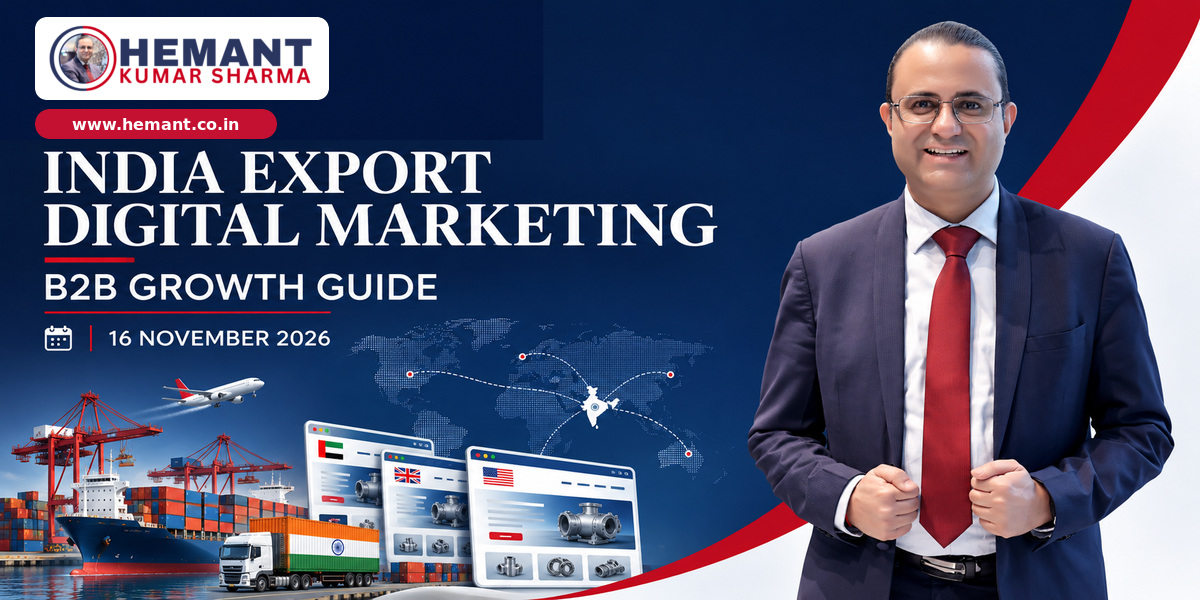
Introduction: Export growth ko generic “global” marketing se waste mat kijiye
India’s combined merchandise and services exports were estimated at US$568.84 billion during April–October FY2026–27, according to a Ministry of Commerce & Industry backgrounder published on 14 November 2026. The official document reports 16.66% year-on-year growth, with merchandise exports up 21.96% and services exports up 10.93%.
This is a meaningful macro signal, but it is not a guarantee that every Indian manufacturer, consultant, SaaS company or service exporter will receive more orders. Export demand depends on sector, destination, compliance, capacity, price, logistics, currency and buyer confidence. Digital marketing can create discoverability and qualified conversations; it cannot repair a noncompetitive offer or missing certification.
The practical opportunity is sharper: export-ready Indian businesses can replace one vague “we export worldwide” page with destination-specific acquisition systems. Search behaviour, proof requirements, procurement language and buying cycles differ across the US, UK, Germany, UAE, Singapore, South Africa and other markets. A credible export strategy should reflect those differences.
Confirmed facts: Official export data kya dikhata hai
The 14 November government backgrounder reports:
- Combined merchandise and services exports for April–October FY2026–27: estimated US$568.84 billion, up 16.66% year on year.
- Merchandise exports: US$309.06 billion, up 21.96%.
- Services exports: estimated US$259.78 billion, up 10.93%.
- October total exports: estimated US$89.99 billion, up 29.90% year on year.
- The document highlights growth across electronics, engineering goods, chemicals, handicrafts, processed food and multiple destination markets.
Official source: https://static.pib.gov.in/WriteReadData/specificdocs/documents/2026/nov/doc_10480_20261114_20382401.pdf
These are government estimates and aggregated trade figures. They do not prove profitability, digital demand or order growth for an individual exporter. Services figures can also be estimates at publication time.
Export-ready hone ka matlab kya hai
Before creating international campaigns, business should pass a basic readiness test.
Commercial readiness
Can the company quote in the buyer’s preferred currency? Are minimum order quantities, production capacity, lead time, Incoterms, payment terms and sample policy defined? Who owns the overseas enquiry after form submission?
Compliance readiness
Certifications, test reports, product standards, labelling and destination-specific documentation should be current. “ISO certified” is not enough if the buyer needs an industry or country-specific standard.
Fulfilment readiness
Shipping, customs, insurance, packaging, returns and after-sales responsibility must be understood. For services, replace logistics with delivery model, timezone overlap, data security, contracts and handover process.
Evidence readiness
Export buyers look for proof: factory details, capacity, case studies, client sectors, quality controls, certifications, references and response discipline. A beautiful website without credible evidence will struggle to generate serious B2B conversations.
Country-specific SEO: Ek page, duniya bhar ka keyword nahi
Map buyer language, not seller language
An Indian manufacturer may call a product by its local trade name, while a US or German buyer uses a specification, application or certification term. Keyword research should include:
- Product and category terms
- Application and industry terms
- Material, size, standard and compatibility terms
- “Manufacturer,” “supplier,” “private label,” “OEM” and “bulk” intent
- Country and city modifiers where commercially relevant
- Problem or compliance queries buyers ask before contacting vendors
Do not translate keywords literally. Validate actual search-result language, distributor catalogues, trade associations and competitor pages in the destination market.
Build market pages with genuine differences
A useful country page should explain shipping route, lead time, currency, relevant certification, product availability, support hours, enquiry ownership and destination-specific proof. Changing only the country name creates thin doorway-style content and weak buyer trust.
If a company is not locally incorporated or staffed, do not imply a local office. Use honest language such as “exporting from India to the UAE” or “serving UK importers from our India facility.”
International technical setup
Choose site structure based on operational capacity: country folders, language folders or a global site with destination pages. Use correct hreflang only when genuine language or regional alternatives exist. Keep canonical tags self-referencing where appropriate, avoid automatic IP redirects that block crawling, and maintain one source of truth for specifications.
B2B landing pages that qualify—not merely collect—leads
An export landing page should help both buyer and sales team decide whether the fit is real.
Include:
- Product range and use cases
- Specifications, standards and customisation limits
- MOQ, sample process or “available on request” policy
- Production capacity and typical lead time
- Packaging and shipping options
- Certifications with scope and validity
- Buyer types served
- Case evidence without breaching client confidentiality
- Named response owner and expected reply window
- A qualification form asking destination, quantity, application, required standard and purchase timeline
Do not hide every useful detail behind a form. Buyers need enough information to trust the business before sharing procurement data.
Distributor and account-based lead generation
Define the account universe
For each priority country, build a manageable list of importers, distributors, integrators, retailers, consultants or enterprise buyers. Segment by size, territory, portfolio fit and likely entry route.
Create an evidence-led outreach sequence
The first email or LinkedIn message should not say “we are a leading exporter.” Reference the buyer’s category, market or portfolio and offer specific proof: compatible product line, certification, capacity, sample or relevant case.
Use three layers:
1. Insight or fit statement.
2. Verifiable capability.
3. Low-friction next step—specification check, sample discussion or short qualification call.
Avoid mass contact lists with weak provenance. Country-specific privacy, electronic-marketing and telemarketing rules may apply. Keep suppression and consent processes documented.
Paid acquisition: Search first, scale later
Google Ads can capture high-intent export demand, but campaigns need commercial guardrails.
Start with exact and phrase themes around product, specification, manufacturer and supplier intent. Exclude consumer, job, free, repair and irrelevant location traffic. Send users to a destination-relevant page—not the homepage.
Track more than form submissions:
- Qualified enquiry rate
- Destination and product fit
- Sample request
- Quote issued
- Sales-qualified opportunity
- Order value and gross margin
- Time to first response
Import offline outcomes into advertising systems only with proper consent, identifiers and governance. A cheap lead from the wrong country or MOQ is not success.
India-specific implications
MSME resource constraints
Many Indian exporters cannot launch ten markets simultaneously. Select two or three markets where certification, logistics and buyer language are manageable. A focused program with one responsible salesperson beats scattered ads across twenty countries.
WhatsApp and response discipline
International buyers may use WhatsApp, but business identity, timezone and handoff should remain professional. Use a company-managed number, standard qualification questions and CRM logging. A late or informal response can undermine strong advertising.
Rupee pricing versus buyer currency
Website can display indicative destination currency, but quotations should state validity, taxes, shipping basis and exchange assumptions. Do not advertise a price that excludes mandatory costs without clear disclosure.
Proof from Indian operations
Factory videos, testing processes, packaging, team expertise and export documentation can create trust when they are authentic and current. Avoid stock imagery that suggests facilities the company does not own.
A 30-day export digital acquisition pilot
Week 1: Market selection
Score three countries on demand, competition, certification, fulfilment, margin, language and internal ownership. Select one primary and one comparison market.
Week 2: Search and proof build
Research buyer terminology and create one destination page with specification, proof, qualification form and clear response promise. Validate technical SEO and mobile performance.
Week 3: Controlled activation
Launch a small Search campaign and a named-account outreach sequence. Align UTM naming, CRM fields, enquiry ownership and SLA. Do not scale before lead quality is reviewed.
Week 4: Commercial review
Classify enquiries by destination, product fit, MOQ, timeline and value. Record objections and missing proof. Improve the page and targeting from actual buyer conversations.
Confirmed facts versus analysis
Confirmed: The government backgrounder reports the April–October export figures, growth rates and highlighted sectors/markets. The publication date is 14 November 2026.
Analysis: Stronger export momentum can support demand for international SEO, account-based outreach and destination-specific acquisition, but digital results will depend on the company’s product-market fit, compliance, fulfilment and sales execution.
Common mistakes to avoid
- One generic “exports worldwide” page for every market
- Claiming a local presence that does not exist
- Translating keywords without validating buyer language
- Running ads before certification and fulfilment are ready
- Counting every form as a qualified export lead
- Hiding specifications and proof behind a form
- Ignoring response time, CRM ownership and offline outcomes
Conclusion
India’s export growth creates context, not customers. The businesses that convert it into overseas demand will combine a competitive offer with market-specific search visibility, credible proof, disciplined outreach and commercial measurement. Start with one market, one buyer segment and one measurable pilot—then scale what produces qualified opportunities.
Use our SEO agency services to plan country-specific landing pages, or explore our Google Ads services when you’re ready to test overseas demand and track qualified enquiries.