
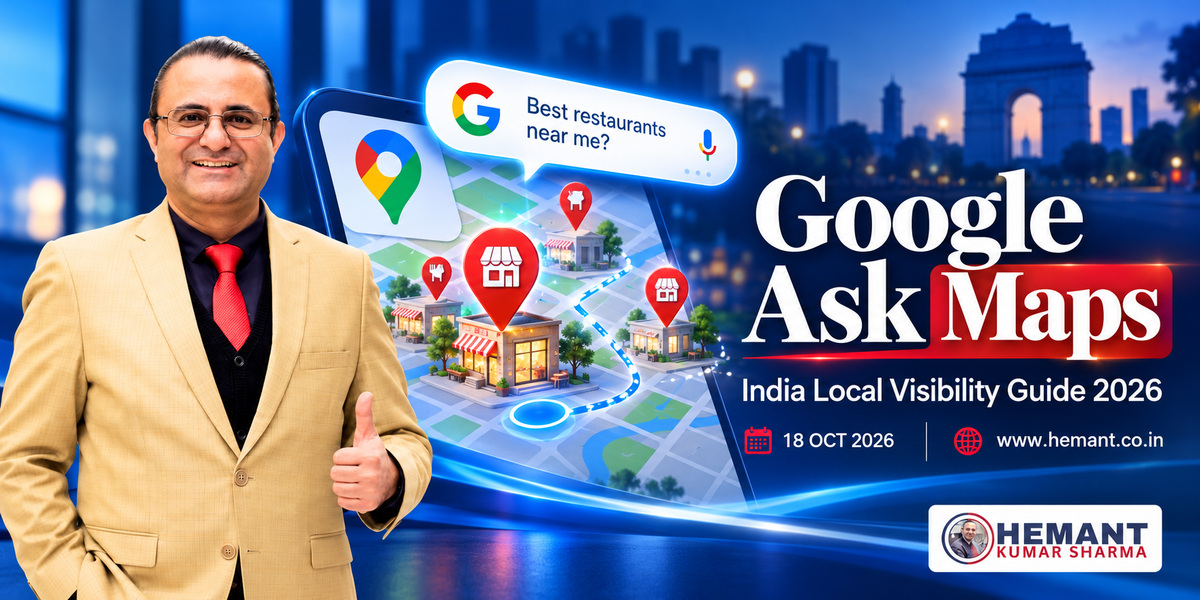
Introduction
Local SEO mein ab sirf “near me” ranking ya three-pack visibility dekhna enough nahi hai. Google Maps ke conversational layer Ask Maps mein user ek complete situation explain kar sakta hai: “quiet cafe jahan client call ho sake,” “family dinner ke liye kids’ play zone wala restaurant,” ya “airport jaane se pehle teen ghante mein kya kar sakte hain?” Answer ek blue-link list nahi, balki context-based recommendation hota hai.
Indian businesses ke liye iska matlab yeh nahi ki koi secret “Ask Maps optimisation” trick aa gayi hai. Google ne Ask Maps ke selection formula ka separate public playbook release nahi kiya. Lekin company ne confirm kiya hai ki experience fresh Maps information, business data, reviews, contributor content aur web information ka use karta hai. Isliye practical opportunity evidence quality improve karne mein hai—profile, website, photos, reviews aur real-world service delivery ko ek consistent story banana.
Business owners ko accurate location information, useful website content aur real customer needs ke basis par local visibility improve karni chahiye.
Confirmed facts: Ask Maps India mein kya available hai?
India launch aur Hindi support
Google ne Ask Maps ko India aur United States mein 12 March 2026 ko introduce kiya. 6 August 2026 ko Google India ne Hindi support, real-time transit information aur Personal Intelligence updates announce kiye. Ask Maps text ya voice mein complex local questions ko interpret karke routes, places aur practical context combine kar sakta hai.
Google ke India announcement ke mutabik Hindi rollout 6 August se start hua. Personal Intelligence optional hai: user Gmail connect karne ka decision khud leta hai, aur connection default se off hai. Calendar integration ko us waqt “soon” kaha gaya tha; isliye usse universal current availability assume nahi karna chahiye.
India aur US features ko mix na karein
Global Google announcement ne food ordering, live hotel prices, events discovery aur conversational place edits ko US rollout bataya, with more countries to come. India post ne Hindi, transit and Personal Intelligence highlight kiya. Isliye Indian agency proposal mein US-only agentic ordering ko India feature kehna factual error hoga.
Google local information kahan se leta hai?
Google Business Profile documentation kehta hai ki local information business owners ke supplied data, publicly available web content, licensed third-party data, user contributions such as photos and reviews, aur Google ke place interactions se compile hoti hai. Local ranking guidance relevance, distance and prominence ko main factors batati hai. Ask Maps ke liye exact recommendation weights public nahi hain, lekin inputs ka ecosystem clear hai.
Ask Maps traditional local SEO se kaise alag hai?
Keyword se situation tak
Traditional query “cafe near me” category aur distance se start hoti hai. Conversational query multiple constraints combine kar sakti hai: quiet atmosphere, laptop-friendly seating, vegetarian options, parking, current opening hours, price comfort aur route convenience. Business ko ab sirf category match nahi, attribute-level evidence bhi chahiye.
Discovery answer ek synthesis hai
Ask Maps user ko “best” option batate waqt business name ke saath explanation de sakta hai. Agar profile mein parking attribute missing hai, website mein accessibility unclear hai aur reviews inconsistent hain, recommendation engine ke paas confident answer dene ke liye weak evidence hoga. Yeh guaranteed ranking rule nahi—professional inference hai—but data completeness ka business case strong karta hai.
Search journey Maps ke andar longer ho sakti hai
User follow-up questions pooch sakta hai, past conversation resume kar sakta hai aur live transit context dekh sakta hai. Isse discovery, comparison aur visit planning ek hi interface mein aa sakte hain. Marketers ko impressions ke saath calls, direction requests, bookings aur store visits jaise downstream actions measure karne chahiye.
India-specific implications
Hinglish intent ko structured evidence chahiye
Indian customers Hindi, English aur Hinglish mix karte hain. Business description ko keyword list banane ki zaroorat nahi, lekin services, neighbourhoods, common use cases aur facilities ko natural language mein clearly explain karna useful hai. “Family restaurant” claim tab strong hoga jab website, menu, photos, attributes aur authentic customer feedback us context ko support kare.
Regional and operational details matter
Festival hours, branch-specific phone numbers, wheelchair access, parking, delivery area, appointment requirement, price range aur payment modes jaise details stale hon to conversational answer misleading ho sakta hai. Multi-location brands ko central governance ke saath local ownership bhi chahiye.
Reviews ko scripted content na banayein
Review volume aur positive ratings local prominence mein help kar sakte hain, but fake or incentivised review schemes policy risk create karte hain. Ethical approach yeh hai ki real customers se feedback maanga jaye, review responses specific hon aur recurring operational complaints actually fix ki jayein.
Practical Ask Maps audit
Step 1: ten real customer situations likhein
Har location ke liye brand-name queries nahi, need-state prompts banayein. Example: “Noida mein quiet coworking cafe open now,” “Gurugram mein kids ke saath Sunday lunch,” “South Delhi mein wheelchair-accessible dentist with evening appointment.” Prompts language, device, time aur location context ke hisaab se test karein.
Step 2: answer quality record karein
Spreadsheet mein date, query, device, language, suggested businesses, reasons, factual errors aur cited evidence note karein. Ask Maps answers dynamic hain; ek screenshot ko permanent rank report na samjhein. Trend dekhne ke liye same test monthly repeat karein.
Step 3: evidence gaps map karein
Har missed or incorrect attribute ko source ke saath map karein: Business Profile, official website page, menu/service page, structured data, photos, review themes ya third-party listing. Correctness first rakhein; sirf answer influence karne ke liye unsupported claims add na karein.
Step 4: profile and website align karein
Name, address, phone, categories, hours and services exact hon. Branch page par location-specific content, nearby landmarks, service area, accessibility and booking method clear ho. Important details image ke andar lock na karein; readable page text bhi provide karein.
Step 5: conversion path test karein
Recommendation milne ke baad call, WhatsApp, booking, directions aur purchase flow mobile par smoothly work karna chahiye. AI visibility without conversion readiness vanity metric ban sakti hai.
Confirmed facts versus analysis
Confirmed facts
- Ask Maps launched in India and the US on 12 March 2026.
- Google announced Hindi support, real-time transit information and optional Personal Intelligence for India on 6 August 2026.
- Gmail connection for Personal Intelligence is off by default and controlled by the user.
- Google’s local-ranking documentation names relevance, distance and prominence.
- Google says business information can come from owner data, public web content, licensed data, contributors and Google’s interactions.
Professional analysis
- Businesses with clearer, consistent attribute-level evidence are better prepared for situational queries, but Google has not promised a ranking uplift.
- Ask Maps testing should complement—not replace—Business Profile performance, analytics, call tracking and real customer research.
- US-only ordering and conversational contribution features should not be sold as available in India until Google confirms expansion.
Conversational local discovery ke liye Google Business Profile promotion services ka scope accurate profile details, location content aur customer enquiry paths ke saath align karein.
30-day action plan
Days 1–7: Verify every location, category, phone, hours, URL and core attribute. Build ten situational prompts per priority branch.
Days 8–14: Test Ask Maps in Hindi and English where available. Record recommendations and factual gaps without treating results as fixed rankings.
Days 15–21: Improve location pages, service details, photos and genuine review-response workflows. Correct inconsistent third-party listings.
Days 22–30: Retest, compare conversion actions and assign a monthly data-quality owner. Escalate errors through official profile-edit or support routes.
Conclusion
Ask Maps local discovery ko conversational bana raha hai, lekin winning strategy familiar fundamentals ki stronger execution hai: accurate profile, useful website, credible customer evidence and frictionless conversion. Indian businesses ko “AI SEO hack” chase karne ke bajay real-world customer situations ko answerable banana chahiye.
Discuss Your Business Strategy
Google Business Profile aur Ask Maps readiness ka practical plan chahiye? Hemant Kumar Sharma ke saath strategic digital marketing consultation explore karein. Call/WhatsApp: +91 98116 81687.
Sources and verification
Google India, “Ask anything about any place on Maps with Gemini,” published and launched 12 March 2026: https://blog.google/intl/en-in/products/explore-communicate/ask-anything-about-any-place-on-maps-with-gemini/
Google India, “Ask Maps gets more helpful in India,” published 6 August 2026: https://blog.google/intl/en-in/products/ask-maps-gets-more-helpful-in-india/
Google Maps global update, published 6 August 2026: https://blog.google/products-and-platforms/products/maps/order-food-in-ask-maps/
Google Business Profile Help, local-ranking guidance, checked 18 October 2026: https://support.google.com/business/answer/7091
Google Business Profile Help, information sources, checked 18 October 2026: https://support.google.com/business/answer/2721884