
The product feed may look fine—until the old API stops
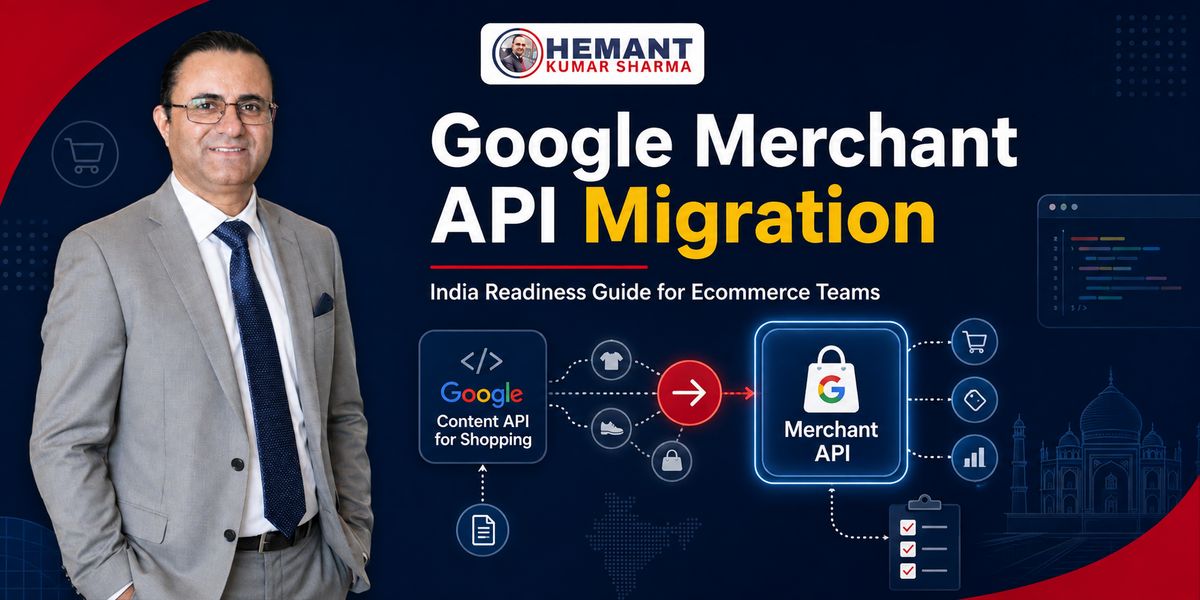
Google’s Content API for Shopping is deprecated and scheduled to shut down in August 2026. Its successor is the Merchant API. For many merchants this sounds like a developer-only issue, but the operational impact can reach product availability, price updates, local inventory, promotions, account management and reporting.
Indian ecommerce teams often have a long chain: ERP or spreadsheet, feed tool, Merchant Center, Google Ads, ecommerce platform and sometimes an agency-built connector. If even one custom integration still calls the Content API, a late migration can create stale data or failed operations at the worst possible moment.
The correct response is not panic and not blind platform trust. First identify who owns the integration. Then test the replacement against real business flows, including India-specific price, MRP, stock, language, shipping and local inventory requirements.
What is confirmed—and what is not
- Google’s official Content API release notes state that the API is deprecated and will be shut down in August 2026.
- Google describes Merchant API as the official successor and provides compatibility and migration guides.
- For third-party ecommerce platforms, Google advises contacting the platform. Its compatibility guide specifically notes that merchants using the Google & YouTube app on Shopify do not need to take direct migration action.
- The Merchant API changes request URLs and resource naming. Common resource identifiers use fields such as name and parent.
- Price representation changes: the compatibility guide describes amount values in micros rather than the older representation.
- Custom batch methods are not supported in Merchant API; Google documents concurrent individual requests as the replacement pattern.
Confirmed fact versus analysis: deprecation status, August 2026 shutdown window and API differences are from Google documentation. Your exact risk, completion date and required engineering effort depend on the connector and cannot be inferred from Merchant Center’s visible feed status alone. Google’s official release note specifies the month, not an exact shutdown day on the cited page; teams should avoid inventing a precise deadline and should complete work immediately.
Who actually needs to act?
Likely low direct engineering effort
If a supported third-party app fully owns the integration, the provider may handle the code change. Shopify merchants using Google’s named app are the clearest official example. Even then, confirm app status, permissions, diagnostics and recent successful product updates. “No coding required” is not the same as “no operational verification required.”
Likely direct migration work
Custom ERP connectors, agency scripts, server-side feed services, internal dashboards and tools calling Content API endpoints need review. Search code, cloud logs, service accounts, scheduled jobs and vendor contracts for shopping-content endpoints, client libraries and deprecated resource names. Do not rely only on the current agency contact; old automations often outlive their creators.
Mixed environments
A business may use a platform app for products but custom code for inventory, local stores or reporting. Build an operation-by-operation inventory rather than a single yes/no status. Account management, data sources, products, promotions, inventories and reports can have different owners and readiness levels.
Key technical changes in plain language
Resource names and request structure
Merchant API uses resource-oriented naming and parent relationships. Code that passes a merchant ID in the old way may need structural changes. Update request construction, not merely the endpoint hostname. Validate identifiers containing special characters and follow the current resource documentation.
Price values in micros
A price representation change is dangerous because a syntactically valid number can still be commercially wrong. Create tests for representative INR prices, sale prices and edge values. Compare what the API accepts, what Merchant Center displays and what Shopping surfaces show. Never test only ₹100; include decimals and higher-value products.
Batching becomes concurrency
If the old process sends custom batch operations, it cannot be copied one-to-one. Google recommends arranging parallel individual requests. Engineering teams must design concurrency limits, retry behaviour, idempotency, partial-failure handling and logs. Faster throughput without safeguards can duplicate work or hide failed products.
Data sources and ownership
Merchant API uses data-source concepts that can affect which source owns a product input. Teams should map each feed, supplemental input and local inventory source before migration. A technically successful write to the wrong source can still produce confusing precedence or overwrite behaviour.
India-specific validation
- Price and sale price in INR: validate formatting, micros conversion and landing-page parity.
- MRP and promotional logic: confirm any maximum retail price and sale-price handling used by your catalogue, based on current supported fields and programme eligibility.
- COD, shipping and serviceability: API success does not prove fulfilment promises are correct across PIN codes.
- Regional and local inventory: test store codes, stock state, local pricing and special-character identifiers.
- GST-inclusive presentation: align feed values with landing pages and the business’s tax presentation; obtain tax advice where needed.
- Language and transliteration: verify titles and descriptions render cleanly for the feeds and markets you actually use.
- High-churn inventory: prioritise SKUs whose price or availability changes frequently because stale data creates the fastest customer harm.
A migration runbook for merchants and agencies
1. Discover
- List every system that reads or writes Merchant Center data.
- Name the internal owner, technical owner and external vendor for each operation.
- Capture service accounts, OAuth scopes, libraries, endpoints, schedules and alert destinations.
- Classify each operation: platform-managed, custom, obsolete or unknown.
2. Map and build
- Use Google’s compatibility overview to map old services and fields to Merchant API equivalents.
- Refactor request paths, resource names, price types and batching patterns.
- Implement structured logging, retries with backoff, partial-failure capture and replay safety.
- Use least-privilege credentials and rotate any credentials exposed during legacy maintenance.
3. Validate
- Run a representative SKU set: active, out of stock, sale price, high value, local inventory and special characters.
- Compare API response, Merchant Center diagnostics, visible product detail and downstream ad eligibility.
- Reconcile counts and error categories, not just HTTP success rates.
- Test rollback and reprocessing before production cutover.
4. Cut over and monitor
- Choose a controlled window and freeze unrelated feed changes.
- Monitor freshness, item issues, rejected items, inventory lag, price mismatches and request errors.
- Keep a named incident owner and a channel for ecommerce, media and engineering teams.
- Retire old jobs and credentials after stable validation so hidden legacy calls do not continue.
What the marketing team should ask engineering
- Are we using Content API anywhere, including reporting or local inventory?
- Which partner owns each integration, and have they confirmed Merchant API readiness?
- What evidence shows the new pipeline is updating prices and stock on time?
- How will we detect partial failures before ads send traffic to stale products?
- What is the rollback and incident plan?
- Which business KPIs will be watched during cutover—disapprovals, eligible product count, spend, conversion rate and revenue?
Conclusion
Merchant API migration ko “backend housekeeping” samajhna risky hai. The API sits underneath product truth—the price, availability and catalogue data customers and campaigns depend on. Identify exposure, separate platform-managed from custom operations, test Indian commerce realities and complete the transition with evidence. Feed continuity is a revenue-control discipline.
Need a practical account review?
If your ecommerce stack has grown through apps, agency scripts and custom feeds, a concise integration audit can uncover migration gaps before they become campaign or customer problems.
For a strategy review, training session, or implementation roadmap, visit Online Paid Consultancy (Extended) or WhatsApp +91 98116 81687.
Sources and verification notes
Confirmed facts above are based on the following primary sources. Dates mentioned are publication or documentation dates, not assumptions about India-specific account availability.
- Google Developers: Content API release notes — official deprecation notice; August 2026 shutdown window
- Google Developers: Merchant API compatibility overview — updated 22 July 2026; official successor and key differences
- Google Developers: Start migration — official migration sequence and service mapping guidance
- Google Developers: Refactor concurrent requests — updated 17 July 2026; replacement for Content API custom batch methods
- Google Developers: Data sources migration — official data-source compatibility guidance