
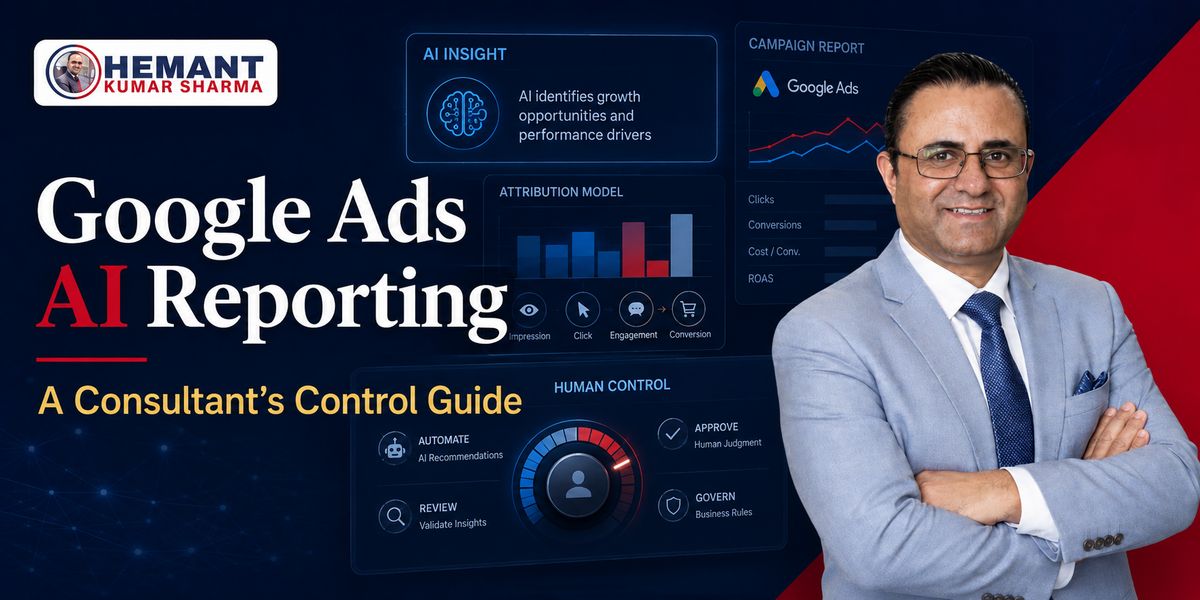
Reporting is getting conversational—but accountability is not
Google announced on 10 August 2026 that it is adding new AI and agentic experiences across Google Ads and Google Analytics. The promise is attractive: homepage summaries that surface meaningful changes, visual reports created through natural-language prompts, explanations of the “why,” and benchmarks against similar businesses.
For an Indian business owner juggling agency calls, sales pressure and cash flow, this can reduce the time between “something changed” and “let us investigate.” But fast answers can also create false confidence. An AI-generated chart is not automatically a causal diagnosis, and a recommended action is not automatically aligned with margin, inventory, compliance or sales capacity.
The opportunity is therefore bigger than faster dashboards. It is to redesign the reporting workflow so AI handles discovery and assembly while humans retain definitions, evidence, approval and business judgment.
What Google has confirmed
- Google Analytics is receiving AI Overviews at the top of the homepage to summarise important changes since the user last logged in.
- Marketers can use natural-language prompts to create visual reports and explore why performance changed.
- Google is adding business benchmarks to help advertisers compare performance with similar businesses.
- The company positions these capabilities as agentic assistance while stating that marketers remain in control.
Confirmed fact versus analysis: these capabilities and Google’s positioning come from its official announcement. The time saved, accuracy achieved and business impact will vary by account, data quality, permissions and product availability. Treat workflow benefits below as recommendations, not guaranteed outcomes.
Where agentic reporting can create real value
1. Daily anomaly triage
Instead of opening ten dashboards, a marketer can begin with changes since the previous login and ask follow-up questions. Useful prompts are specific: “Show campaigns where spend rose more than conversion value,” “Compare brand and non-brand conversion rates,” or “Explain whether the drop is traffic, conversion rate or average order value.” The AI becomes a first-pass investigator, not a final authority.
2. Faster stakeholder views
Business owners, performance teams and sales teams need different views. Natural-language report creation can reduce analyst bottlenecks: the owner sees contribution and trend, the media buyer sees auction and bidding signals, and sales sees lead quality by source. The metric definitions must remain shared, otherwise prettier reporting only scales disagreement.
3. Hypothesis generation
A useful agent can suggest plausible drivers—seasonality, traffic mix, conversion-rate movement or campaign changes. This shortens the path to questions worth testing. It should not convert correlation into causation. The appropriate next step may be a segment check, experiment or CRM reconciliation, not a budget change.
The four risks Indian teams should control
Metric ambiguity
“Revenue,” “lead” and “ROAS” often mean different things across Ads, Analytics, CRM and finance. India-specific realities—GST treatment, COD, cancellations, returns and marketplace orders—can widen the gap. Create a one-page measurement dictionary before asking AI to interpret performance.
Incomplete data and consent boundaries
If tagging, consent signals, offline conversions or cross-domain measurement are incomplete, an articulate answer can still be wrong. Limit who can access sensitive commercial data. Do not paste personal customer information into prompts. Follow organisational privacy and security policies, and involve legal or security teams where necessary.
Automation bias
People tend to accept confident machine output, especially under time pressure. Require evidence links, named date ranges and comparison baselines. A recommendation without an explicit metric, segment and expected trade-off should not proceed to execution.
Uncontrolled changes
If the same interface can analyse and act, permissions matter. Separate read-only exploration from campaign-changing authority. High-impact actions—budget increases, target changes, campaign launches, conversion changes—should have a human approval checkpoint and rollback plan.
A practical human-in-the-loop workflow
- Frame the business question: write the decision to be made, not merely the chart to be produced.
- Lock the metric definition: source, attribution model, time zone, currency, inclusion rules and conversion lag.
- Ask the AI for observation first: what changed, where, when and by how much. Keep interpretation separate.
- Request alternative explanations and disconfirming evidence. A good review tests the strongest competing hypothesis.
- Verify in source reports and relevant systems such as CRM, ecommerce backend or finance data.
- Define the proposed action, owner, risk limit and rollback condition.
- Record the prompt, output summary, reviewer and decision. This creates a lightweight audit trail.
- Review outcomes after enough data has accrued; feed learning back into the reporting playbook.
Better prompts for business users
Vague prompt: “Why did performance fall?” Better prompt: “Compare the last complete seven days with the previous comparable seven days, exclude the current partial day, and separate the change into traffic, conversion rate and average conversion value. Show the top three contributing campaigns and flag tracking anomalies.”
Vague prompt: “What should I optimise?” Better prompt: “Identify campaigns where incremental spend may be justified, but show the evidence, conversion delay, lead-quality caveat and expected downside. Do not propose an account change.”
Prompt quality is governance in miniature. It establishes scope, evidence, exclusions and authority.
Agency and consultant implications
Clients will increasingly ask why they should pay for reporting if a platform can summarise the account. The answer cannot be “because we make slides.” Consultant value moves upward: measurement design, business context, creative diagnosis, cross-platform triangulation, experiment planning and accountable action.
A strong monthly review should therefore show three layers: platform-confirmed observations, the consultant’s interpretation, and agreed decisions with owners. This explicit separation improves trust and prevents an AI summary from being presented as settled truth.
A 30-day adoption plan
- Week 1: inventory access, conversions, metric definitions and known data gaps.
- Week 2: test AI summaries on historical periods where the team already knows the outcome; document misses and useful patterns.
- Week 3: introduce read-only anomaly triage and stakeholder-specific report templates.
- Week 4: add approval rules, decision logs and post-action reviews. Expand only after the workflow is reliable.
Conclusion
Agentic reporting ka best use faster answers nahi, faster disciplined decisions hai. Let the system scan, summarise and assemble. Keep humans responsible for definitions, causality, commercial context and permission to act. Teams that build this control layer now will gain speed without surrendering judgment.
Need a practical account review?
If your dashboards generate plenty of numbers but few confident decisions, the right next step is a measurement and AI-governance workshop—not another reporting template.
For a strategy review, training session, or implementation roadmap, please book a Strategic Online Consultation Session or WhatsApp +91 98116 81687.
Sources and verification notes
Confirmed facts above are based on the following primary sources. Dates mentioned are publication or documentation dates, not assumptions about India-specific account availability.
- Google Ads & Commerce: Evolve your marketing with new AI tools — published 10 August 2026; official announcement and feature description
- Google: Ads Advisor and Analytics Advisor — published 12 November 2025; official background on Google’s advisor direction