
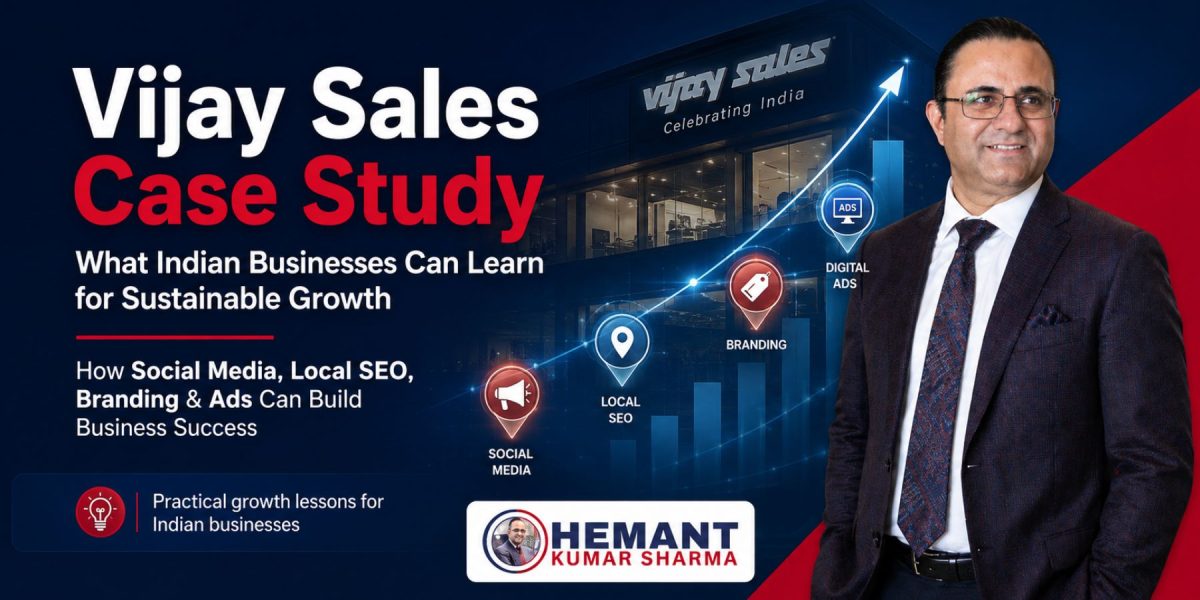
Aaj ke business environment mein growth ko aksar speed ke saath measure kiya jaata hai.
Kitne followers aaye?
Kitne cities mein expansion hua?
Kitna advertising budget spend hua?
Kitne leads generate hue?
Kitni jaldi valuation badhi?
Lekin har sustainable business ki kahani speed se nahi likhi jaati.
Kuch businesses decades tak quietly apna market samajhte hain, customer behaviour observe karte hain, operational discipline banate hain aur phir ek strong position ke saath expansion karte hain.
Vijay Sales is approach ka ek valuable Indian example hai.
Company ki official history ke according, Vijay Sales ki journey 1967 mein Mumbai ke Mahim area mein ek small electronics showroom se shuru hui. Initial product range mein sewing machines, fans aur transistors the; black-and-white televisions baad mein product mix ka hissa bane. Aaj company apne aap ko India ki prominent electronics retail chains mein count karti hai, with more than 170 showrooms stated on its official website.
Is journey ko sirf “small shop to big company” wali motivational story samajhna incomplete hoga.
The more useful question is:
What business decisions helped such a retailer survive changing technologies, new competitors, online marketplaces, regional expansion and constantly shifting customer expectations?
Aur usse bhi important question:
Aaj ka Indian business Vijay Sales jaise traditional growth principles ko Social Media, Local SEO, Branding aur Digital Ads ke saath kaise combine kar sakta hai?
This article is not an endorsement of every viral claim circulating about Vijay Sales. Some social-media narratives around valuation, supplier credit and zero dead stock remain unsupported or exaggerated. Instead, this case study focuses on the broader lessons that can be reasonably derived from verified company history and credible financial information.
Lesson 1: Start Small, but Observe the Market Deeply
Vijay Sales did not begin as a national chain.
It began with one local market, one physical location and a limited product range.
Yeh point Indian entrepreneurs ke liye bahut important hai. Kaafi business owners shuruat se hi multiple cities, dozens of products, nationwide delivery aur every-platform marketing ka pressure create kar lete hain.
The result is often:
- weak operational control,
- confused brand positioning,
- inconsistent customer experience,
- high advertising waste,
- poor cash-flow visibility.
A smaller starting point gives a business something valuable: the opportunity to understand customers before attempting to scale them.
A local business should first study:
- Customers kis problem ke saath aa rahe hain?
- Purchase se pehle unke doubts kya hote hain?
- Competitors ke comparison mein business kyun choose kiya ja raha hai?
- Kaunse products enquiries generate karte hain but sales nahi?
- Repeat customers kis reason se wapas aate hain?
- Complaints repeatedly kis stage par arise hoti hain?
Growth ka first step more advertising nahi hota.
Growth ka first step better observation hota hai.
Digital application for today
Aaj ye observation sirf shop-floor conversations tak limited nahi hai.
Businesses insights collect kar sakte hain through:
- Google Business Profile reviews,
- website search data,
- Google Search Console queries,
- Instagram comments and DMs,
- WhatsApp enquiry patterns,
- Meta Ads lead quality,
- customer-service conversations,
- sales-team feedback.
A modern business ko marketing data aur ground-level customer feedback ko alag nahi rakhna chahiye. Dono ko combine karke strategy banani chahiye.
Lesson 2: Customer Experience Can Be a Marketing Channel
Retail mein display, demonstration aur physical experience ka major role hota hai.
Vijay Sales ki official timeline states that it introduced a stronger product-display concept for customers in Mumbai. Whether every competitor kept televisions switched off—as some viral posts claim—is difficult to verify. But the larger strategic lesson remains valid: customers are more likely to buy products they can properly experience.
This principle applies beyond electronics.
A furniture showroom should help people visualise a room.
A clothing brand should help customers imagine an occasion.
A consultant should help prospects understand the process.
A trainer should demonstrate the learning outcome.
A restaurant should communicate taste, hygiene and ambience.
A manufacturer should show use cases, specifications and quality control.
Many businesses still treat marketing as something that happens before the customer arrives.
In reality:
Customer experience itself becomes marketing when people remember it, discuss it and recommend it.
Digital application for today
Social Media can extend the physical experience beyond the store.
A retailer can publish:
- product demonstrations,
- side-by-side comparisons,
- buying guides,
- installation walkthroughs,
- real customer questions,
- staff recommendations,
- maintenance advice,
- behind-the-scenes quality checks,
- new-arrival previews,
- customer success stories.
This content does not merely “keep the account active.”
It reduces purchase anxiety.
A customer considering an expensive product may not buy after seeing one promotional post. But after watching three useful Reels, reading customer reviews and checking a detailed comparison, the brand starts appearing credible.
That is why educational content often contributes more to sales than repetitive offer creatives.
Lesson 3: Own One Market Before Chasing Every Market
Vijay Sales’ expansion history reflects a measured approach. Its official timeline shows that the company remained concentrated in Mumbai and nearby markets for a long period before expanding into cities such as Pune, Surat, Ahmedabad and Delhi.
This may appear slow when compared with venture-funded expansion models.
But controlled expansion has advantages:
- management understands the operating model,
- team training becomes repeatable,
- suppliers gain confidence,
- customer service standards mature,
- local brand recognition deepens,
- expansion mistakes become less expensive.
Indian SMEs often make the opposite mistake.
They start targeting:
- Delhi,
- Mumbai,
- Bengaluru,
- Dubai,
- the UK,
- the USA,
all at once—even before establishing a strong position in their own locality.
The issue is not ambition. The issue is sequence.
A better geographic growth sequence
An Indian local business can consider this order:
Stage 1: Immediate locality
Win visibility around the primary office, store or service area.
Stage 2: Nearby localities
Expand where delivery, service and reputation can be managed comfortably.
Stage 3: City-level positioning
Build category authority across the city.
Stage 4: Regional expansion
Enter neighbouring districts or states with adequate systems.
Stage 5: National or international marketing
Scale only after operational capacity, brand consistency and customer support are ready.
This does not mean a business must wait for decades.
Digital platforms compress time. But digital speed should not be used to hide operational weakness.
The Role of Local SEO in Controlled Business Expansion
Vijay Sales grew through physical-market presence. Aaj ke business ko usi local dominance ko digital form mein build karna hoga.
This is where Local SEO becomes crucial.
When someone searches:
- electronics store near me,
- business consultant in Rohini,
- digital marketing trainer in Delhi,
- saree shop near me,
- interior designer in Noida,
- dentist in South Delhi,
Google tries to identify the most relevant, credible and geographically suitable businesses.
A company may have an attractive website and active Instagram account, but without local optimisation it may remain invisible at the moment when a customer is ready to enquire.
Local SEO steps Indian businesses should follow
1. Optimise the Google Business Profile
The profile should contain:
- accurate business name,
- correct category,
- address and service areas,
- phone number,
- website,
- operating hours,
- products or services,
- business description,
- high-quality photographs,
- regular updates.
Keyword stuffing in the business name should be avoided. Consistency and authenticity are more valuable than artificial optimisation.
2. Build location-specific website pages
A business serving multiple locations should not simply duplicate one page and replace the city name.
Each location page should include:
- locally relevant service details,
- genuine customer context,
- nearby service areas,
- delivery or visit information,
- location-specific FAQs,
- original images where available,
- local testimonials where genuine.
3. Develop a review-generation system
Reviews influence both trust and local visibility.
Customers should be politely encouraged to leave honest feedback after successful delivery or service completion.
Businesses should also respond to reviews professionally—especially negative ones.
A thoughtful response can show future customers that the company listens, takes responsibility and works towards resolution.
4. Maintain business information consistency
Business name, address, phone number and website details should remain consistent across:
- Google Business Profile,
- website,
- Facebook,
- Instagram,
- local directories,
- trade portals,
- map listings.
Conflicting details reduce trust and can create customer confusion.
Lesson 4: Controlled Growth Protects the Brand
One of the claims in the viral carousel states that Vijay Sales avoided franchising and prioritised company control.
Publicly available sources indicate a mix of self-owned and leased stores, but a categorical “no franchises ever” claim requires direct documentary confirmation. Still, the broader lesson is useful: expansion without control can dilute the brand.
Brand dilution happens when different branches, employees, partners or agencies communicate the business differently.
For example:
- one branch promises premium service,
- another competes only on price,
- one social page uses formal communication,
- another publishes poor-quality creatives,
- one salesperson commits unrealistic timelines,
- another avoids after-sales responsibility.
The logo may remain the same, but the brand experience becomes inconsistent.
What Indian businesses should standardise before scaling
Before opening another location or adding another channel, document:
- brand positioning,
- visual identity,
- tone of communication,
- customer-service process,
- quotation format,
- sales promises,
- complaint-handling rules,
- pricing boundaries,
- social-media standards,
- response timelines.
A brand is not merely what management says.
A brand is the consistency customers experience across every touchpoint.
Branding: Why Recognition Alone Is Not Enough
Many Indian businesses are known in their locality but cannot be clearly described by customers.
People recognise the shop name.
They know the owner.
They may have purchased before.
But when asked why the business is different, they have no clear answer.
This means the business has awareness but weak positioning.
Vijay Sales built recognition around electronics retail, product choice, store experience and trusted purchasing. A modern business must similarly define its own territory in the customer’s mind.
A useful positioning framework
Every business should answer:
Who do we serve?
Be specific about the audience.
What problem do we solve?
Do not merely list products.
Why should customers trust us?
Use experience, process, proof and customer outcomes.
How are we meaningfully different?
Avoid generic claims such as “best quality” and “excellent service.”
What should people remember after seeing our communication?
This should guide every advertisement and social post.
For example, a digital marketing consultant should not merely say:
“We provide SEO, social media and ads.”
A stronger positioning statement could be:
“We help Indian SMEs diagnose marketing gaps before spending heavily on execution and advertising.”
The second statement creates a clearer strategic identity.
Lesson 5: Build Business Assets You Can Control
The VISE brand is a significant part of the Vijay Sales story. Vijay Sales’ own websites identify VISE as its private label for categories such as televisions, air conditioners and washing machines.
A private label can potentially offer:
- greater control over product positioning,
- stronger pricing flexibility,
- higher differentiation,
- improved customer retention,
- reduced dependence on external brands.
Not every business can launch a product label, but every business can build owned assets.
These include:
- a strong website,
- an email subscriber list,
- a customer database,
- original educational content,
- proprietary frameworks,
- documented processes,
- branded service packages,
- customer communities,
- training material,
- original research,
- a recognisable brand identity.
Businesses relying entirely on Amazon, Instagram, Justdial, marketplaces or third-party platforms are building on rented ground.
Platforms are important, but they should direct customers towards assets the business can control.
Social Media: Not a Replacement for Business Strategy
Social media can accelerate recognition, education and engagement.
But it cannot repair a weak offer.
A business with poor service, unclear pricing and inconsistent fulfilment may gain temporary reach, but visibility will eventually expose its weaknesses.
Therefore, Social Media should perform four specific roles.
1. Educate
Explain what customers should know before purchasing.
Examples:
- mistakes to avoid,
- comparison guides,
- expected costs,
- product-selection criteria,
- process explanations,
- common myths.
2. Demonstrate
Show the product, service or expertise in action.
Examples:
- before-and-after results,
- product demos,
- client journeys,
- behind-the-scenes execution,
- live problem-solving.
3. Build familiarity
People buy more comfortably from brands they repeatedly see and understand.
Regular content creates mental availability.
4. Create social proof
Customer reviews, testimonials, project outcomes and case studies help reduce perceived risk.
However, social proof must remain genuine. Fabricated reviews and exaggerated outcomes can damage the business more than they help it.
Lesson 6: Use Acquisitions, Partnerships and Advertising Only After Strategic Readiness
Vijay Sales acquired TMC Electronics in 2019, obtaining an immediate entry into Telangana and Andhra Pradesh. Contemporary reporting described TMC as having 19 stores, while later sources have referred to a larger store count associated with the South India expansion. The acquisition itself is well established, but viral descriptions such as “rebranded overnight” are not supported by the initial reporting, which said the TMC name would continue at first.
The lesson is not simply “acquire another business.”
The deeper lesson is:
When entering a new market, existing local trust can be more valuable than starting from zero.
A smaller Indian business may not acquire another company, but it can use:
- local distribution partners,
- strategic collaborations,
- complementary service providers,
- regional influencers,
- industry associations,
- channel partners,
- reseller networks.
Partnerships should provide more than reach. They should add trust, capability or local understanding.
Google Ads and Meta Ads: Different Roles in the Growth System
Digital advertising is often treated as a quick solution:
“Leads chahiye? Ads chala do.”
This approach is incomplete.
Ads amplify whatever already exists.
If positioning is strong, ads accelerate clarity.
If positioning is weak, ads accelerate confusion.
If landing pages are persuasive, ads support conversion.
If customer service is slow, ads generate wasted enquiries.
Google Ads: Capture existing demand
Google Ads is particularly useful when customers are actively searching for a solution.
Examples:
- “electronics store near me”
- “digital marketing consultant Delhi”
- “AC repair service Rohini”
- “corporate trainer India”
- “buy washing machine online”
Google Ads can help a business appear at a high-intent moment.
But success requires:
- tightly structured keywords,
- negative keywords,
- location targeting,
- relevant ad copy,
- dedicated landing pages,
- genuine conversion tracking,
- call and form measurement,
- regular search-term analysis.
A business should not judge Google Ads only by clicks.
It should track:
- qualified calls,
- completed forms,
- WhatsApp conversations,
- booked appointments,
- sales value,
- cost per genuine enquiry.
Meta Ads: Create and shape demand
Meta Ads on Facebook and Instagram work differently.
Users are usually not searching actively. The advertisement interrupts their content consumption.
Therefore, creative communication matters heavily.
Meta Ads can work well for:
- product discovery,
- visual categories,
- seasonal offers,
- retargeting,
- local awareness,
- lead generation,
- educational campaigns,
- audience nurturing.
A good Meta campaign often requires multiple creative angles:
- problem awareness,
- product demonstration,
- testimonial,
- comparison,
- offer,
- founder story,
- FAQ,
- remarketing reminder.
One creative should not be expected to carry an entire campaign indefinitely.
A Practical Growth Roadmap for Indian Businesses
The Vijay Sales journey suggests that sustainable growth is built in layers.
A modern Indian business can follow this practical sequence.
Phase 1: Diagnose the Business
Before investing heavily in promotion, review:
- product-market fit,
- profit margins,
- customer segments,
- competitive position,
- conversion problems,
- repeat-purchase potential,
- operational capacity.
Do not advertise a problem that has not yet been solved internally.
Phase 2: Clarify the Brand
Develop:
- positioning statement,
- core audience,
- value proposition,
- brand message,
- visual identity,
- communication tone,
- proof points.
Every team member and marketing partner should understand this foundation.
Phase 3: Strengthen the Digital Foundation
Build or improve:
- mobile-friendly website,
- service and category pages,
- location pages,
- Google Business Profile,
- analytics,
- Search Console,
- conversion tracking,
- contact options,
- speed and usability.
Phase 4: Build Organic Visibility
Create useful content through:
- website blogs,
- local pages,
- Instagram Reels,
- carousels,
- YouTube explainers,
- LinkedIn insights,
- FAQs,
- customer stories.
Content should answer genuine buying questions, not merely chase trends.
Phase 5: Start Advertising Carefully
Begin with focused campaigns.
Do not target all of India unless the business can genuinely serve all of India.
Test:
- one market,
- one audience,
- one clear offer,
- one landing page,
- a controlled budget,
- properly configured conversions.
Phase 6: Improve Conversion Systems
Review how quickly and professionally leads are handled.
Track:
- response time,
- enquiry quality,
- quotation follow-up,
- reasons for rejection,
- sales closure,
- customer acquisition cost.
Marketing is not complete when a lead arrives.
Phase 7: Scale What Has Been Proven
Expansion should follow evidence.
Increase geography, budget, products or locations only after establishing:
- consistent demand,
- healthy margins,
- reliable fulfilment,
- repeatable customer acquisition,
- dependable customer service.
What Vijay Sales Teaches Beyond Retail
The strongest lesson from the Vijay Sales story is not about electronics.
It is about disciplined growth.
The business appears to have combined:
- patient market development,
- physical customer experience,
- gradual geographic expansion,
- controlled retail operations,
- category expertise,
- private-label development,
- strategic acquisition.
CARE Ratings reported FY25 total operating income of approximately ₹10,597 crore, compared with about ₹8,659 crore in FY24, alongside improved profitability. These figures provide credible evidence of the scale achieved, although they do not validate every valuation or revenue figure circulating on social media.
Today, an Indian business does not need to copy Vijay Sales store by store.
It should copy the underlying discipline.
Build trust before demanding attention.
Understand the local market before chasing the national market.
Create an experience before promoting an offer.
Strengthen operations before increasing ad spend.
Develop brand assets instead of depending entirely on third-party platforms.
Use technology to accelerate a working model—not to disguise a broken one.
Final Perspective: Traditional Discipline, Modern Distribution
Vijay Sales began in an era without Instagram, Google Maps, online reviews, e-commerce retargeting or performance advertising.
Modern businesses have access to extraordinary tools.
A small neighbourhood company can now:
- appear in local Google searches,
- demonstrate products through Reels,
- educate customers through YouTube,
- retarget website visitors,
- generate enquiries through Google Ads,
- build a subscriber database,
- reach customers across cities.
But tools do not replace judgement.
The combination Indian businesses need is:
Traditional business discipline + modern digital distribution.
Social Media can create familiarity.
Local SEO can generate high-intent discovery.
Branding can build recognition and preference.
Google Ads can capture active demand.
Meta Ads can introduce and nurture demand.
But sustainable growth arrives only when these channels are connected to a credible product, clear positioning, responsive team and dependable customer experience.
Vijay Sales’ journey reminds us that growth does not always have to be loud.
Sometimes, the business that appears slow is actually building depth.
And when depth finally meets distribution, growth becomes much harder for competitors to copy.