
India mein doctors aur clinics ke liye digital visibility ka importance clearly badh chuka hai. Patients ab sirf reference se doctor nahi dhoondhte; woh Google Search, Google Maps, clinic website, location details, consultation timings, and online information ko bhi dekhte hain. Lekin healthcare category ek ordinary business category nahi hai. Is field mein digital marketing ka approach sirf “reach badhao” wala nahi ho sakta. Yahan trust, ethics, law, patient dignity, confidentiality, and professional conduct sab equally important hote hain. Isi liye doctors aur clinics ko random social media posting se zyada, ek consultant-led, compliant digital strategy ki zarurat hoti hai.
Sabse pehle ek very important clarification. User language mein log ab bhi “Medical Council of India” bol dete hain, lekin statutory regulator ab National Medical Commission (NMC) hai, jo National Medical Commission Act, 2019 ke under constituted hua. NMC ki website par yeh clearly stated hai ki NMC Act 2019 came into force on 25 September 2020. Isliye doctors aur clinics ke digital conduct ko discuss karte waqt present regulatory reference NMC framework ke saath samajhna chahiye, even though older MCI ethics regulations still remain highly relevant in the regulatory chain and are hosted by NMC itself.
Is article ka purpose kisi bhi tarah ki aggressive promotion, patient solicitation, cure-claim marketing, ya unethical medical branding ko encourage karna nahi hai. Balki opposite. Yeh blog un doctors, clinics, and hospital administrators ke liye hai jo yeh samajhna chahte hain ki Indian law and ethics ke andar rehkar digital visibility kaise build ki ja sakti hai. NMC-hosted Code of Medical Ethics Regulations, 2002 explicitly states that direct or indirect patient solicitation by a physician through advertising is not allowed, and the same source also indicates restrictions on using one’s name as a subject of advertising or publicity. NMC’s 2023 professional conduct regulations also discuss how doctors should behave on public social media platforms, signalling that online conduct is now an explicit ethics issue, not an informal side activity.
Digital Marketing for Doctors Cannot Be Treated Like Fashion, Real Estate, or Retail
Yeh sabse basic but most ignored truth hai. Aaj social media par jo formulas restaurants, salons, coaches, retailers, or ecommerce brands ke liye kaam karte hain, woh healthcare par directly apply nahi kiye ja sakte. Doctor ki online presence ka objective “viral hona” nahi hona chahiye. Objective hona chahiye: accurate information, discoverability, trust, professional dignity, appointment clarity, patient guidance, and reputation protection. NMC’s ethics framework and social-media-related provisions show that the doctor’s online conduct remains part of professional conduct. Isi liye doctor-led digital presence ko healthcare ethics ke lens se hi design karna chahiye.
Agar doctor ya clinic bina guidance ke random digital agency ke saath chalta hai, toh bahut common mistakes hoti hain: flashy reels, overpromising creatives, “best doctor” type claims, treatment guarantees, before-after implication, emotional fear marketing, unverified health tips, patient confidentiality risk, and social media posts that look more like sales ads than healthcare communication. Yeh sab sirf brand issue nahi hain; inmein legal aur ethical exposure bhi ho sakta hai. Isi liye digital marketing consultant for doctors ka role execution se pehle strategy aur compliance alignment ka hota hai.
NMC Rules Ka Practical Meaning: Kya Avoid Karna Chahiye
NMC-hosted Code of Medical Ethics Regulations says that soliciting patients directly or indirectly through advertising is not permitted. The same ethics source also notes that a physician should not use their name as the subject of advertising or publicity, and separately flags even matters like unusually large signboards as improper. The older ethics framework further allows only limited formal announcements in specific contexts such as starting practice, change of type of practice, change of address, temporary absence, resumption, succession, and similar factual notices. In plain language, iska matlab yeh hua ki doctors ko flashy promotional marketing ke bajaye factual, dignified, and patient-helpful communication par focus karna chahiye.
Isi liye is article mein jo bhi digital approach discuss ki ja rahi hai, woh “doctor advertisement” ke aggressive model par based nahi hai. Yeh ethical discoverability model hai. Difference samajhiye. Ethical discoverability ka matlab hai:
clinic ko patient dhoondh sake;
doctor ki qualifications aur timings clear hon;
location, department, speciality aur appointment method visible ho;
public health education helpful ho;
reputation false claims se nahi, trust se build ho.
Yeh approach law-respectful bhi hai aur long-term mein smarter bhi.
Toh Phir Consultant Ki Zarurat Kahan Padti Hai?
Yahin par consultant ka role clear hota hai. Ek good digital marketing consultant for clinics random posting calendar nahi bechta. Pehle yeh samajhta hai:
doctor solo practice mein hain ya multi-speciality clinic mein;
local patient base kitna important hai;
Google Maps visibility weak hai ya website weak hai;
appointment journey easy hai ya confusing;
clinic ki online information fragmented hai ya consistent;
health content educational hai ya generic;
social media presence compliant hai ya risky.
Healthcare mein consultant ka role “more content” se pehle “right content and right visibility” hota hai.
Case Studies : Practical Healthcare Digital Presence Experience
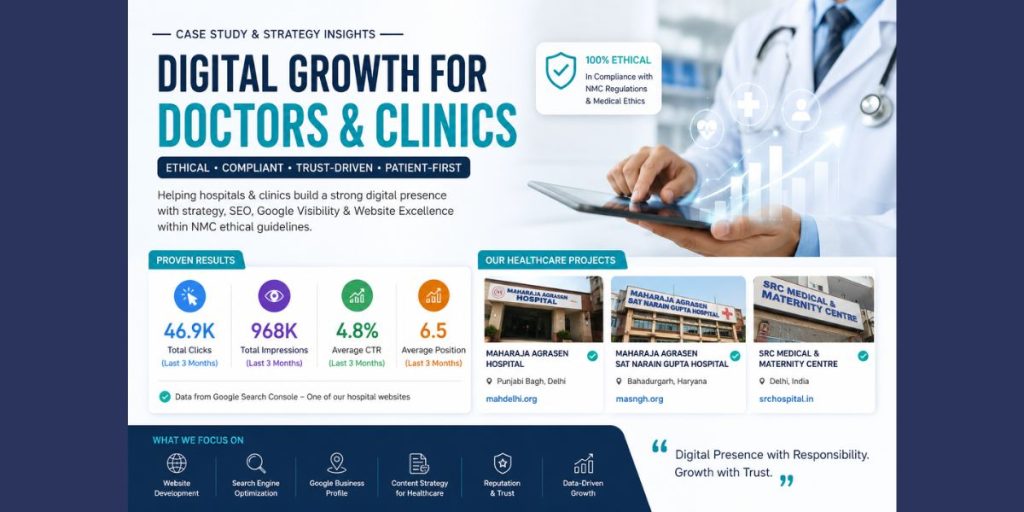
As part of our healthcare digital presence work, we have been associated with the web hosting, website design/development, SEO support, and digital visibility management of three established hospital/medical institutions in Delhi NCR: Maharaja Agrasen Hospital, Punjabi Bagh — www.mahdelhi.org, Maharaja Agrasen Sat Narain Gupta Hospital, Bahadurgarh — www.masngh.org, and SRC Medical and Maternity Centre, Delhi — www.srchospital.in. The objective of this work has not been aggressive medical advertising, but structured digital accessibility, better website experience, accurate online presence, improved search visibility, and easier discovery of important hospital information such as departments, doctors, location, contact details, emergency information, and patient-support sections.
For one of the hospital websites, Google Search Console data showed strong organic visibility, including approximately 46.9K clicks and 968K impressions over a 3-month period, with an average position around 6.5 and average CTR around 4.8%. In the 28-day view, the website recorded around 15.2K clicks and 291K impressions, indicating consistent search presence for relevant hospital-related queries. The branded query visibility also remained strong, with the hospital name-related search appearing around Position 1 in the shared Search Console view. These results indicate the value of a technically maintained, search-friendly, and information-led healthcare website.
In another case, the Google Business Profile visibility of SRC Medical and Maternity Centre reflected meaningful local presence, with the profile showing 4.7 rating, 65 Google reviews, and over 1,000 customer interactions in the visible dashboard. For healthcare institutions, such digital presence should always be handled with care. The focus should remain on factual information, patient convenience, local discoverability, trust-building, and ethical communication — not on exaggerated claims, fear-based messaging, or direct patient solicitation. This is exactly where a consultant-led healthcare digital strategy becomes valuable.
1. Local Search and Maps Are More Important Than Random Reels
Doctors aur clinics ke case mein local search ka importance bahut high hota hai. Patients often search by speciality + area, clinic near me, hospital near me, consultation hours, emergency availability, or map directions. Google’s business guidance states that complete and accurate Business Profile information helps businesses appear for relevant local searches and helps customers find and learn more about them. Healthcare category mein yeh aur important ho jaata hai because patient intent often immediate ya proximity-based hota hai.
Lekin yahan bhi consultant-led approach zaroori hai. Clinic listing mein kya likhna hai, kaise categories choose karni hain, doctor profiles kaise present karne hain, services ko kaise phrase karna hai, timings aur contact accuracy kaise maintain karni hai, yeh sab blindly nahi kiya jaana chahiye. Consultant help karta hai ki local visibility strong ho, lekin tone factual aur professional rahe. Yeh “promotion” se zyada “patient access” ka model hota hai.
2. Website Is Not a Brochure; It Is a Trust Document
Doctors ke liye website ka role ecommerce landing page jaisa nahi hota. Clinic website ka role hota hai:
speciality clarity,
doctor qualifications,
clinic location,
consultation process,
department information,
patient guidance,
appointment route,
and trust-building.
Google’s SEO Starter Guide emphasizes making pages understandable, helpful, and structured so users and search engines can clearly understand what the page is about. Healthcare websites especially benefit when pages are clear, service-specific, and genuinely useful. Consultant yahan decide karta hai ki site ko ethical authority format mein kaise structure kiya jaye, taaki patient ko information mile without crossing into claim-heavy advertising.
Indian context mein iska future impact strong hai. Jitne zyada patients online search karenge, utni zyada importance hogi clean medical websites ki. Clinics jo sirf Instagram par active hain but website weak hai, unki trust journey incomplete reh sakti hai. Aur jo website ethical, informative, and easy-to-navigate hogi, woh long-term mein zyada stable digital asset banegi.
3. Health Education Content Matters, But It Must Be Responsible
Doctors ke liye content strategy ka matlab viral entertainment nahi, public education with professional restraint hona chahiye. NMC’s 2023 professional conduct regulations explicitly mention patient interactions on public social media and indicate that if patients approach doctors through public social media, doctors should guide them appropriately rather than casually handling patient matters in open public threads. That strongly suggests caution, privacy awareness, and professionalism in social media use.
Isliye consultant-led healthcare content generally is tarah ka hona chahiye:
common condition awareness,
prevention tips,
when to seek medical advice,
clinic process information,
seasonal health alerts,
myth vs fact education,
screening awareness,
post-consultation general guidance where appropriate.
Lekin consultant ko ensure karna hota hai ki content specific patient advice, diagnosis in comments, sensational claims, or “guaranteed treatment outcome” wali language mein na chala jaye. Indian healthcare content ka future yahin hai: less hype, more trust.
4. Reputation Management Is Not Optional for Clinics
Healthcare mein reputation sirf branding topic nahi hota; it is patient trust infrastructure. Patients often judge credibility through clinic information consistency, overall digital hygiene, educational tone, and publicly visible presence. Consultant ka kaam fake praise collect karna nahi hona chahiye. Safer and stronger route hota hai factual presence, accurate profiles, good information architecture, and a dignified patient communication system. Since the ethics rules restrict advertising-style solicitation and publicity, reputation building in healthcare should lean toward transparency, accessibility, and professionalism rather than aggressive persuasion.
Future mein iska impact aur strong hoga because AI-generated junk content aur generic “best doctor” pages online aur badhenge. Jo clinics real information aur ethical presentation maintain karenge, woh patients ko relatively zyada trustworthy lagenge. Yeh especially metro cities aur tier-2 cities dono mein visible trend ban sakta hai.
5. Social Media Can Help, But Only in a Controlled Role
Is article ka title deliberately kehta hai: not just random social media posts. Reason simple hai. Doctors ke liye social media supportive channel ho sakta hai, central growth engine nahi. Social media ka compliant use ho sakta hai:
clinic updates,
awareness posts,
public education,
camp announcements where lawful and factual,
doctor introduction in professional tone,
health observation days,
facility information.
Lekin consultant ko har post par yeh filter lagana chahiye:
kya yeh factual hai?
kya yeh fear-based nahi hai?
kya yeh patient solicitation jaisa nahi lag raha?
kya yeh privacy-safe hai?
kya yeh overclaim nahi kar raha?
NMC’s rules on social media behaviour and the broader ethics restrictions on advertising make this filtering essential.
6. Consultants Help Doctors Avoid Outsourced Compliance Mistakes
Bahut baar problem doctor ki intention nahi hoti, problem outsourced marketing team ka template mindset hota hai. Ek non-specialist agency healthcare client ke liye wohi tactics use kar sakti hai jo cosmetic brand ya coaching institute ke liye karti hai. Yahin biggest risk hai.
A good medical practice marketing consultant doctor ya clinic ko yeh samjhata hai:
what is safe to publish,
what should stay factual,
what should not be exaggerated,
how to structure pages and profiles,
how to respond to public queries,
how to keep online presence patient-friendly but ethics-compliant.
Yeh role India mein aur important hoga because digital outsourcing badh rahi hai but healthcare compliance understanding har agency mein nahi hoti.
7. For Hospitals and Multi-Doctor Clinics, Governance Matters Even More
Solo doctor aur hospital ki digital needs same nahi hoti. Hospital ya multi-speciality clinic ko:
department pages,
multiple doctor profiles,
location structure,
service discoverability,
emergency information,
patient information flow,
and brand governance
sab manage karna hota hai.
Is scale par consultant ka role aur critical ho jaata hai because ek wrong creative ya exaggerated line poore institution ko compliance trouble mein daal sakti hai. Isliye hospitals ko particularly policy-led content approvals, factual profile formats, and controlled digital publishing workflow maintain karna chahiye. NMC’s ethics infrastructure and EMRB role underline that professional conduct is regulated, not optional.
What a Compliant Digital Strategy for Doctors Should Look Like
Indian doctors and clinics ke liye compliant digital strategy ka practical framework kuch is tarah hona chahiye:
website and local search first,
accurate business and doctor information,
ethical educational content,
professional tone,
no cure guarantees,
no flashy solicitation language,
no public handling of patient-specific medical advice on open social media,
no dependence on random promotional gimmicks,
and strong internal review before publishing anything public.
Yeh model slow lag sakta hai, lekin healthcare mein slow-and-clean often long-term mein fast-and-risky se better hota hai. NMC’s rules allow narrow factual announcements in certain situations, but the broad ethics direction remains clearly against advertising-style solicitation and publicity.
Conclusion
Doctors aur clinics ko digital presence ki zarurat hai, ismein koi doubt nahi. Lekin unhe ordinary digital marketing nahi, regulated and trust-led digital strategy chahiye. Indian medical ethics framework ke under patient solicitation style advertising allowed nahi hai, and online conduct on public social media is now explicitly part of professional conduct. Isi liye healthcare digital growth ka smart route flashy promotion nahi, ethical visibility hai.
Isliye “random social media posts” ka model healthcare ke liye weak bhi hai aur risky bhi. Better model hai consultant-led approach jahan local search, website clarity, educational content, patient trust, and compliance ek saath socha jaye. Mere hisaab se aane wale time mein India mein wahi doctors aur clinics stronger digital credibility build karenge jo online world mein loud nahi, reliable dikhenge. That is not just safer. It is wiser.
Digital Marketing Consultant for Clinics
Agar aap doctor, clinic owner, hospital administrator, ya healthcare practice manager hain aur aapko ek aisi digital strategy chahiye jo Indian medical ethics rules ka respect kare, patient trust build kare, aur aapki online visibility ko random promotion ke bajaye sensible structure de, toh Hemant Kumar Sharma ke saath strategic consultation consider ki ja sakti hai. Unka focus healthcare category mein flashy advertisement banana nahi, balki compliant digital direction, local visibility thinking, website clarity, and ethical content planning par hota hai. Healthcare mein growth ka right path often loud marketing nahi, responsible visibility hota hai.
Frequently Asked Questions
1. Can doctors and hospitals do digital marketing in India?
Doctors, clinics, and hospitals can maintain an online presence, but it must be handled carefully and ethically. The focus should be on factual information, patient education, location visibility, appointment convenience, doctor profile accuracy, and service information. Aggressive advertising, exaggerated claims, cure guarantees, and direct patient solicitation should be avoided.
2. Why do doctors need a digital marketing consultant instead of random social media posting?
Healthcare is a sensitive and regulated category. Random social media posting may lead to wrong messaging, over-promotional content, privacy concerns, or non-compliant claims. A digital marketing consultant can help doctors and clinics build a responsible strategy around website clarity, SEO, Google Business Profile, patient education, and ethical visibility.
3. What kind of digital marketing is suitable for doctors and clinics?
Suitable digital marketing for doctors and clinics may include website improvement, search engine optimisation, Google Business Profile optimisation, informative blog content, doctor profile structuring, department/service information, location-based visibility, and general health awareness content. The tone should remain professional, factual, and patient-helpful.
4. Can doctors use social media for patient education?
Yes, doctors can use social media for general health awareness and education, but they should avoid giving patient-specific diagnosis or treatment advice in public comments or open platforms. Social media content should be informative, responsible, and professionally restrained.
5. Is Google Business Profile important for clinics and hospitals?
Yes. Google Business Profile is important because many patients search for doctors, clinics, hospitals, directions, timings, phone numbers, and departments through Google Search and Maps. Accurate profile information, correct categories, updated timings, photos, and contact details can improve patient convenience and local discoverability.
6. What should doctors avoid in online marketing?
Doctors and clinics should avoid exaggerated claims, “best doctor” style self-promotion, guaranteed treatment results, before-after style misleading content, fear-based messaging, patient data exposure, fake reviews, and public medical advice for individual cases. Healthcare communication should remain factual, dignified, and compliant.
7. How can a digital marketing consultant help a hospital or clinic?
A consultant can review the website, local search presence, Google Business Profile, SEO structure, content plan, social media communication, reputation signals, and patient journey. The consultant can then suggest a compliant and practical roadmap focused on ethical visibility, information clarity, trust, and accessibility. This helps hospitals and clinics avoid random marketing and build a more responsible digital presence.